
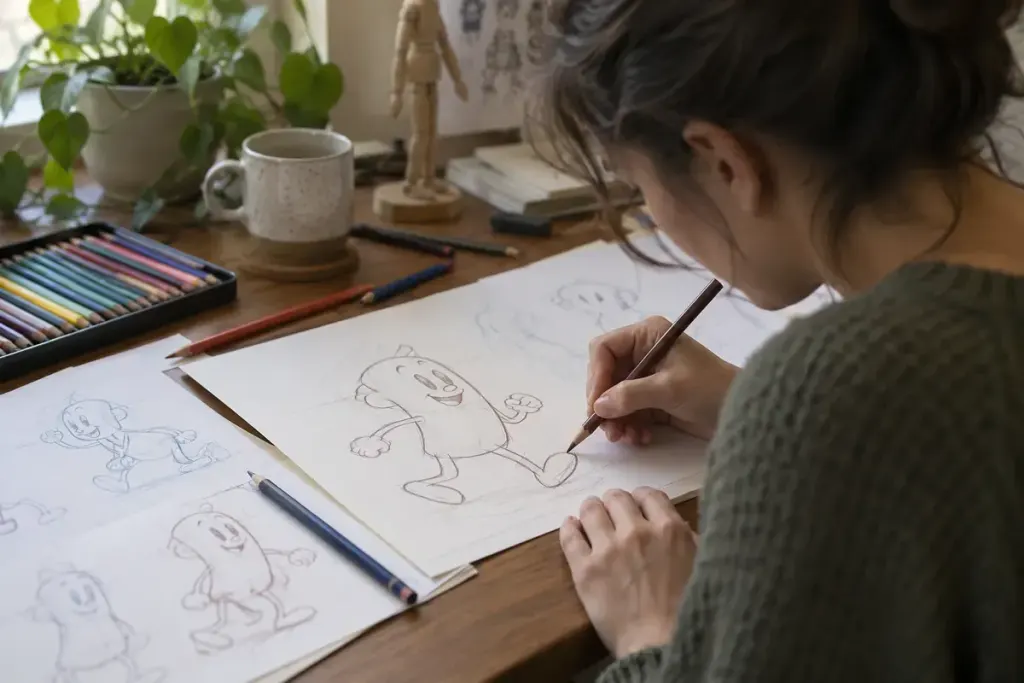
A small flour sack lands on a floor in an animation exercise. It becomes shorter and wider, then rises into a taller shape as it recovers. The drawing changes dramatically, yet the sack can still feel like the same object.
That continuity is the interesting part of squash and stretch. The animator is changing proportions while preserving a convincing impression of how much material the object contains.
Watch the silhouette before the details
Toon Boom’s explanation of the principle connects this deformation with a sense of flexibility and volume. An object that stretches upward may narrow sideways; an object that compresses may spread outward. The effect is perceived through a sequence, not judged solely from one paused frame.
For your own observation exercise, imagine the sack without a face, label or decorative pattern. Sketch its resting outline, a compressed outline and an elongated outline. If the second drawing simply becomes smaller in every direction, the sack may seem to lose material rather than compress.
Now place those sketches beside one another. Where would the filling move? Which edge meets the ground? Those questions encourage a physical relationship between the shapes instead of three unrelated poses.
How far can the shape travel?
The appropriate amount depends on the object and the style of the scene. A restrained character performance may use subtle deformation, while an elastic comic action can push the silhouette much further. A rigid prop does not need to behave like a soft sack merely because it appears in animation.
When watching an anime sequence, compare a moment of impact with the surrounding poses. Ask whether the changed shape communicates force, weight or expression. Do not assume that every unusual paused drawing is a mistake: its job may be to connect two readable moments at speed.
A useful final check for a short exercise is to remove all decorative detail and play the sequence again. If the changing silhouette still suggests one object responding to an action, the deformation is doing useful work. If it seems to inflate and deflate accidentally, revisit the relationship between width, height and the surrounding poses before adding more detail.