
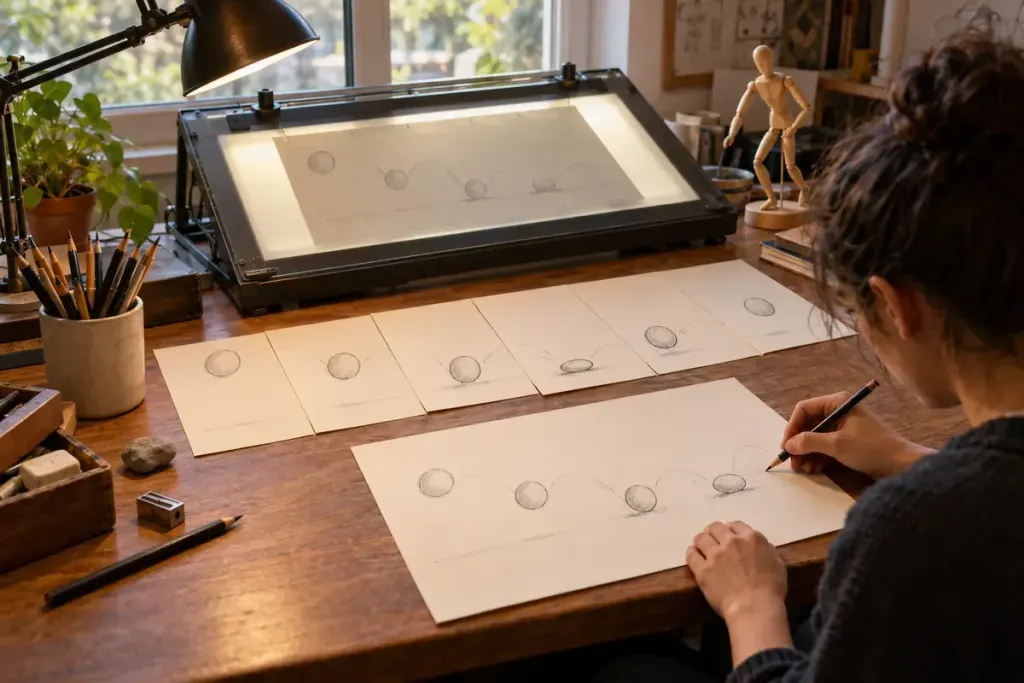
Draw a circle on the left of a page and another on the right. The distance is fixed, but the journey between them can feel steady, hesitant or suddenly fast. Animation creates that difference through the placement and presentation of the intervening images.
Adobe’s introduction to animation techniques discusses timing as a foundation of motion. For a useful practical distinction, timing concerns how long an action takes, while spacing concerns how far the subject moves between successive displayed positions.
Keep the duration, change the journey
Make a simple study with a dot moving from point A to point B over twelve equal time intervals. First, divide the distance into equal steps. Played back at a constant rate, the dot travels at a steady speed.
For a second version, put the early positions close together and make later gaps progressively wider. Keep the same starting point, ending point and number of intervals. The action now accelerates even though its total duration has not changed.
For a third version, reverse that pattern. Large early gaps and smaller later gaps produce a movement that slows towards the destination. These are original practice exercises, not measurements of a particular anime scene.
Look beyond the drawing count
A production can hold one drawing for more than one frame. Consequently, counting unique drawings does not fully describe an action’s timing. Note how long each pose remains visible as well as where the subject appears.
When studying a scene, choose one clear feature, such as a hand or the centre of a moving object. Track that feature instead of switching between different points on the character. Ask where the gaps widen, where they compress and which pose receives a pause.
Then watch at normal speed again. A frame-by-frame explanation is useful only if it helps you understand the motion the audience actually experiences. Small spacing changes can alter the weight and intention of an action without adding a more elaborate drawing.