
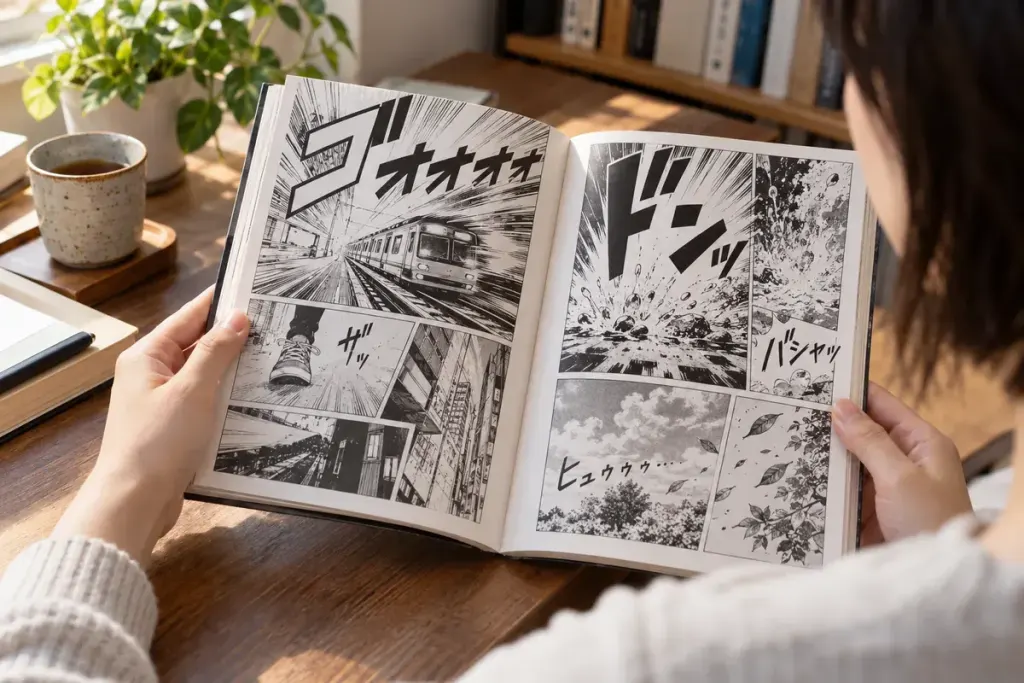
A sound effect in manga is part of the drawing as well as part of the language. Large jagged letters can interrupt a calm panel; small repeated marks can make a quiet action feel persistent. You can notice these choices even before you know how every character is pronounced.
Begin by looking at where the lettering sits. Does it overlap a figure, follow a movement or remain in an empty area? Its placement directs attention and can alter the pace at which you read the panel.
Compare the effect with the visible action
Choose a short sequence in a legally obtained edition. Describe what is visibly happening, then note the size, shape and repetition of the sound lettering. Ask whether the effect emphasises impact, duration, atmosphere or a character’s perception.
Do not assume every effect represents a literal noise. Manga can use expressive lettering to suggest a mood or state as well as an audible event. If the meaning is uncertain, check the edition’s translation notes or a reliable language reference rather than assigning an English sound from appearance alone.
Notice what the translation preserves
Some editions replace the original lettering, while others retain it with a nearby translation or glossary. These approaches create different reading experiences. Compare the relationship between words and artwork, not just whether a translation is present.
For an invented example, a repeated small tapping effect might make waiting feel longer, while one large impact word could make a single instant dominate the page. The observation concerns the sequence’s design; it does not prove the artist intended one exact emotional response.
In a reading journal, identify the volume and page, then explain the effect in your own words. Avoid reproducing a long sequence merely to illustrate the point. Paying attention to lettering adds another layer to a familiar chapter: you begin to see how the page suggests sound without ever becoming an audio track.