
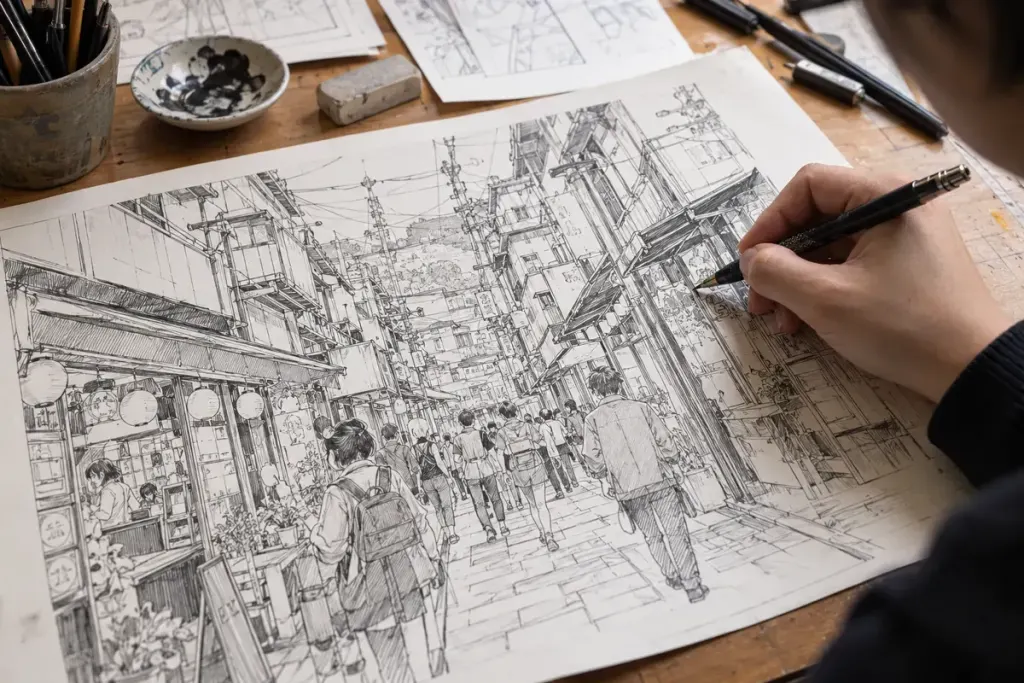
A manga panel can show a crowded street inside a small rectangle. You understand which person is closer, which shop sits farther away and where the path continues. Before looking for a complicated perspective construction, notice the simpler visual clues.
Follow the overlaps
Choose a panel from a copy you can read legally. Identify one shape that partly covers another. A foreground sleeve might interrupt the outline of a person behind it; a sign might hide part of a building. Describe the overlap without assuming every hidden shape has been fully drawn.
Now compare repeated objects. If similar lamps or figures become smaller along a street, their changing scale can suggest distance. The comparison works best when the objects are sufficiently alike for the size difference to be meaningful.
Separate depth from importance
A large face may be close to the viewer, but manga can also enlarge an element for emphasis or organise a page symbolically. Check the surrounding scene before treating every size difference as a literal measurement of space.
In an invented panel, a foreground hand overlaps a desk while a small window appears behind the seated character. Those relationships suggest a room. A second panel might float the same hand beside a memory image, where ordinary room depth is no longer the main organising idea.
Try a three-shape exercise
Draw three simple original shapes in a rectangle. First separate them evenly. Then overlap two and change the size of the third. Compare how the arrangement feels without adding shading or increasing the panel size.
Return to the manga panel and note which clue did the most work: overlap, scale, position or a combination. Keep the observation specific to that image. The exercise is not a rule that every artist must follow; it gives you language for noticing how a flat page can make space feel readable.