
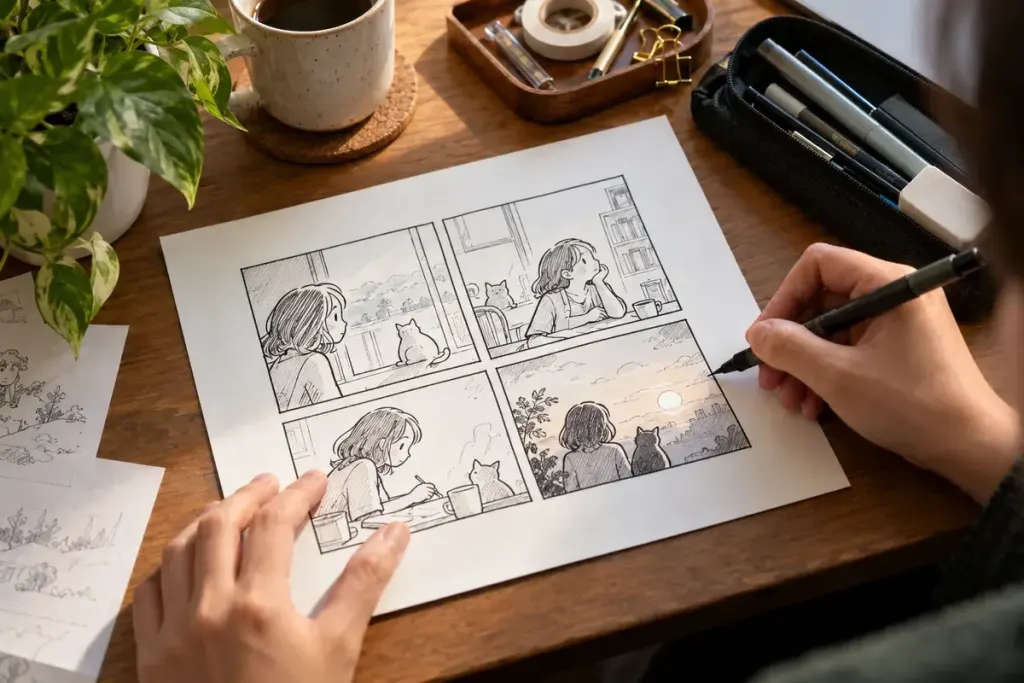
Four small panels can hold a complete comic idea. The limited space encourages the reader to notice what changes between images: a glance, an object moving or a final line that makes the earlier panels mean something different. Yonkoma is especially useful for studying that economy.
The Japan Foundation’s yonkoma workshop description identifies the form as a four-panel comic strip, generally using similarly sized panels to present a brief story or scene, often with humour. That describes a format, not a requirement that every strip use the same joke structure.
Read once for the scene, once for the timing
On the first reading, follow the strip in its indicated order without analysing it. On the second, ask what each panel adds. Does the second repeat the first with a small variation? Does the third create an expectation? Does the fourth confirm that expectation, reverse it or quietly reveal something you overlooked?
Consider an original invented sequence: a person places a “quiet study” sign on a desk; they silence a phone; they close a noisy window; the final panel reveals their own stomach making the interruption. The last image changes the source of the problem. It works because the earlier actions established a clear expectation.
Now imagine moving the final information into panel two. The reader knows the source earlier, so the remaining panels need a different purpose. Rearranging a simple invented sequence helps explain pacing without copying a published strip.
Pay attention to visual continuity as well. Repeated framing can make a tiny change easier to notice, while a changed viewpoint can reveal information deliberately withheld. Dialogue is only one part of the timing.
When discussing a real work, identify the creator and edition and describe the effect in your own words. A short close reading should help someone appreciate the artist’s choices, rather than reproduce the entire strip or reduce every four-panel work to one formula.