
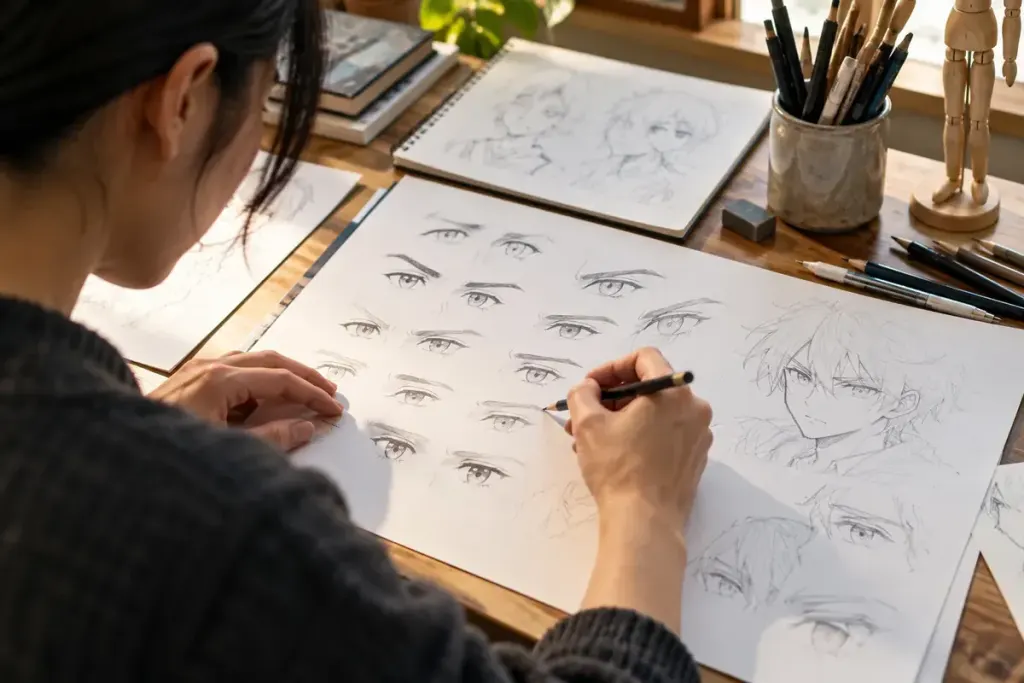
A character says nothing, yet a small eyebrow movement changes how the pause feels. The eyes and mouth may remain almost still while the face shifts from attentive to doubtful. Looking closely at that change reveals how economical animation can be.
Choose a short scene you can revisit legally. Watch it once at normal speed before pausing. The expression belongs to a sequence, and an isolated frame can exaggerate or hide the effect of timing.
Separate the moving parts
Notice the height, angle and symmetry of the brows. Then look at the eyelids, gaze direction, mouth and head tilt. Avoid assigning a fixed emotion to one eyebrow shape without considering those other details.
For a drawing exercise, make three copies of a simple original face. Keep the eyes and mouth unchanged while altering only the eyebrows. Label the versions with the impression they give you, then ask another viewer what they see without showing your labels.
Differences in interpretation are useful. They reveal that expression depends on context and the viewer, rather than functioning as a perfectly universal dictionary. A raised brow can feel curious, sceptical or playful depending on the surrounding action.
Return to the timing
Watch when the movement begins relative to dialogue or a cut. A reaction that arrives before a line can suggest anticipation; one held after it can give the audience time to reconsider the exchange. Describe the actual timing before claiming what the director intended.
Keep observations distinct from interpretation in your notes. “The left brow rises while the mouth stays closed” is something you can point to. “The character has stopped believing the speaker” is a reading that needs support from the scene.
When sharing analysis, identify the work and episode accurately and use only material you have permission to reproduce. Your own sketches can demonstrate the principle without copying an entire sequence. The strongest close reading makes a small visible choice easier for someone else to notice.