
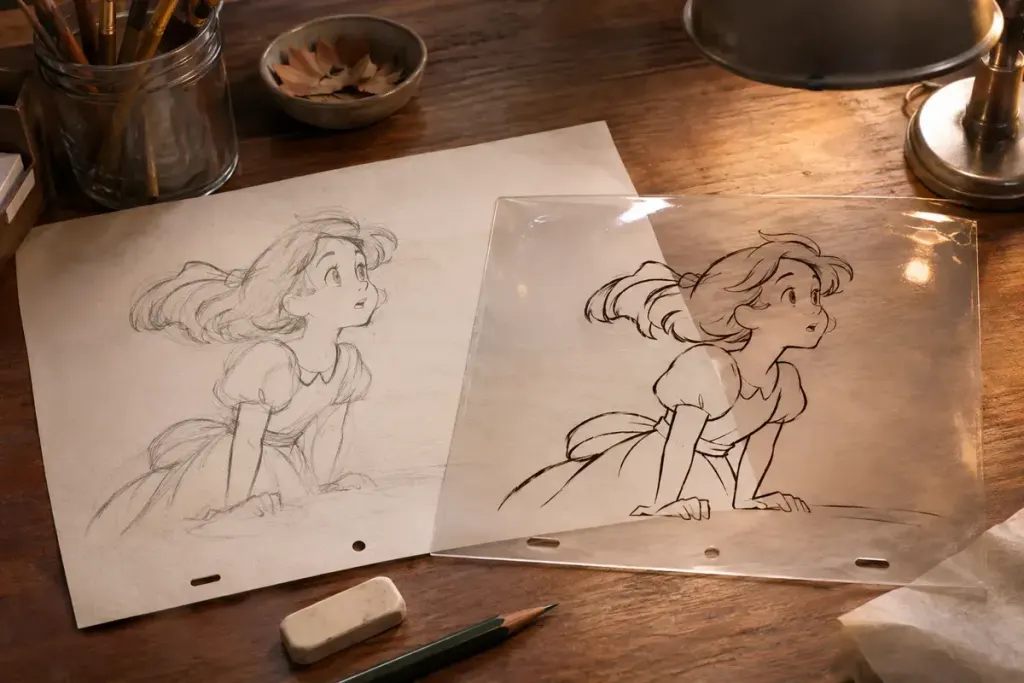
The lively outlines in an animated film can tell a production story of their own. In Disney’s One Hundred and One Dalmatians, the drawn line became especially noticeable as xerography helped transfer animation drawings onto cels.
The Walt Disney Family Museum’s account of the film’s production describes the role of the process and Ub Iwerks’ technical work. Reproducing lines photographically through xerographic technology changed a stage that had depended heavily on hand inking.
A transfer method still begins with drawings
The machine did not invent the performance, decide the pose or solve the timing. Artists still had to create the animation and complete the other production stages. Calling the result “copied” without that context confuses the reproduction of a drawing with the creation of the drawing itself.
The visible line could retain qualities associated with the animator’s drawing. That makes the film interesting to examine for texture as well as movement, although a viewer should not assume that every mark on screen belongs unchanged to a single original sketch.
A short viewing exercise
Choose a quiet moment rather than a rapid action sequence. Look first at a character’s silhouette: where does the line feel firm, and where does it seem more exploratory? Then compare details inside the outline, such as a folded ear or the shape around an eye.
On a second viewing, notice the background. Ask how its shapes and colours work with the character’s outline. This is an observation exercise; identifying a production method from one isolated frame alone can be unreliable.
It also helps to compare scenes within the same film before making claims about an entire studio or decade. Different productions, restoration choices and viewing copies can affect the apparent finish.
Xerography is useful to know about because it connects an industrial process to an aesthetic result. Once that connection becomes visible, the outline stops being merely the edge of a coloured shape. It becomes part of the film’s visual voice, supported by both technical invention and the decisions of the artists using it.