
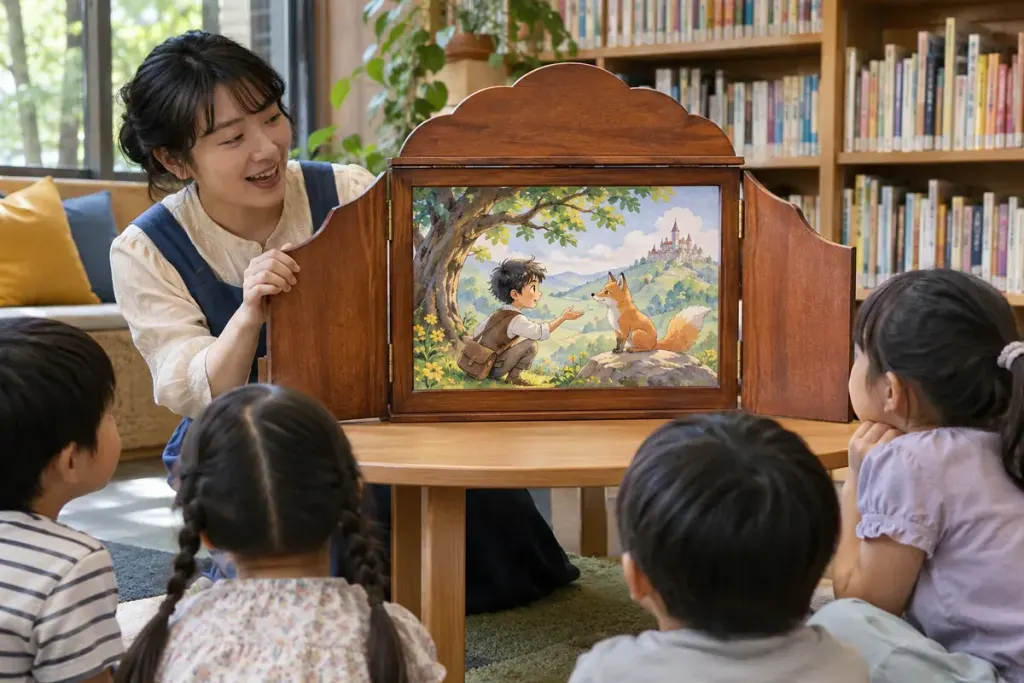
A storyteller slides one illustrated board away and reveals the next. The audience waits for that movement as much as for the next sentence. In kamishibai, pictures and live narration share the work of carrying a story.
The Hoover Institution Library & Archives introduction describes kamishibai as Japanese paper theatre, using illustrated cards and a narrator, often with a portable wooden stage. The format makes the act of revealing an image part of the performance.
The audience does not turn the page
When reading a comic, a reader can hurry ahead, pause or glance back. In a live kamishibai performance, the narrator controls the sequence of visible images. A held picture can build anticipation; a quick change can create surprise.
Watch how much information an image gives before the narration explains it. A character’s position, an empty doorway or an object at the edge of the frame can invite the audience to predict what comes next. The illustration is not merely a background for spoken text.
Try a three-board storytelling exercise
For a small original exercise, draw three scenes: someone notices a problem, tries a solution and discovers the result. Keep the story your own or use material you have permission to adapt. Make the images clear enough to understand from a short distance.
Tell the story once while changing boards as soon as a sentence ends. Then repeat with a deliberate pause before the final reveal. Ask listeners what changed in their expectation. This is an exercise in timing, not an attempt to reproduce every historical form of kamishibai.
Keep the history wider than one technique
The medium has included different purposes and contexts, from street entertainment to education. A University of Zurich introduction distinguishes those strands.
For anime and manga readers, kamishibai offers another way to think about sequential images: who controls the pace, when the audience receives information and how a still picture can hold attention. The most revealing moment may be the brief silence before the next board appears.