
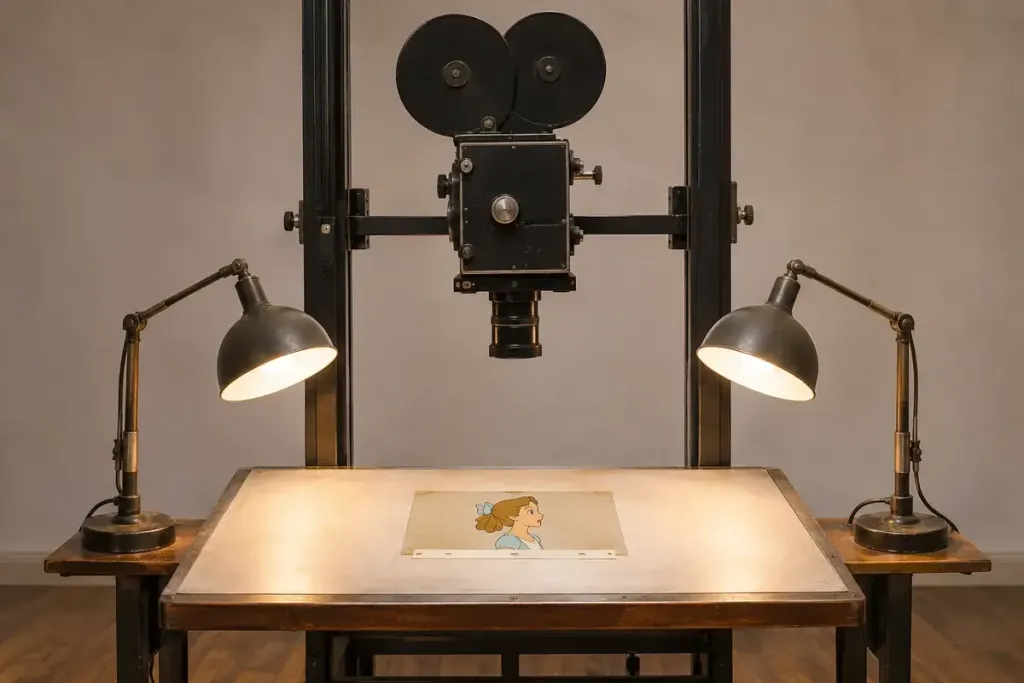
A painted cel is an object you can hold. To become part of a film, it also had to be photographed. For viewers exploring the craft behind older animation, the camera stand is an important piece of that missing middle stage.
An animation rostrum positions a camera over artwork so images can be recorded in a controlled sequence. The Powerhouse museum’s Australian rostrum, built in 1964, combines a film camera, a rigid stand and a table for the artwork. Its documentation describes registration equipment, a rotating table and a camera carriage mechanism.
This is a documented Australian example of animation equipment, not evidence that a particular Japanese studio used this exact machine. It offers a concrete way to understand the physical capture stage when studying the wider history of animation and anime.
Two movements to keep separate
A character can change because successive pieces of artwork show different poses. A composition can also change because the view of the artwork changes. Those are different operations even when the finished shot makes them feel like one continuous action.
Try a small paper exercise: draw a landscape with a recognisable tree, then look at it through a rectangular opening cut in another sheet. Slide the opening sideways without redrawing the landscape. You have changed the visible composition while the marks on the page remain the same. This is an illustration of framing, not a reconstruction of a studio camera system.
Look beyond the finished frame
In an archival photograph of an animation setup, identify where the artwork rests, where the lens points and what keeps repeated positions consistent. Ask which parts can move deliberately and which need to stay stable. A camera hovering loosely over a desk would create a very different production problem.
Then return to a scene you enjoy. Observe changes in framing and changes in the character separately, without claiming you can identify every production technique from the final picture. The equipment gives you better questions to ask about how drawings became a photographed sequence.