
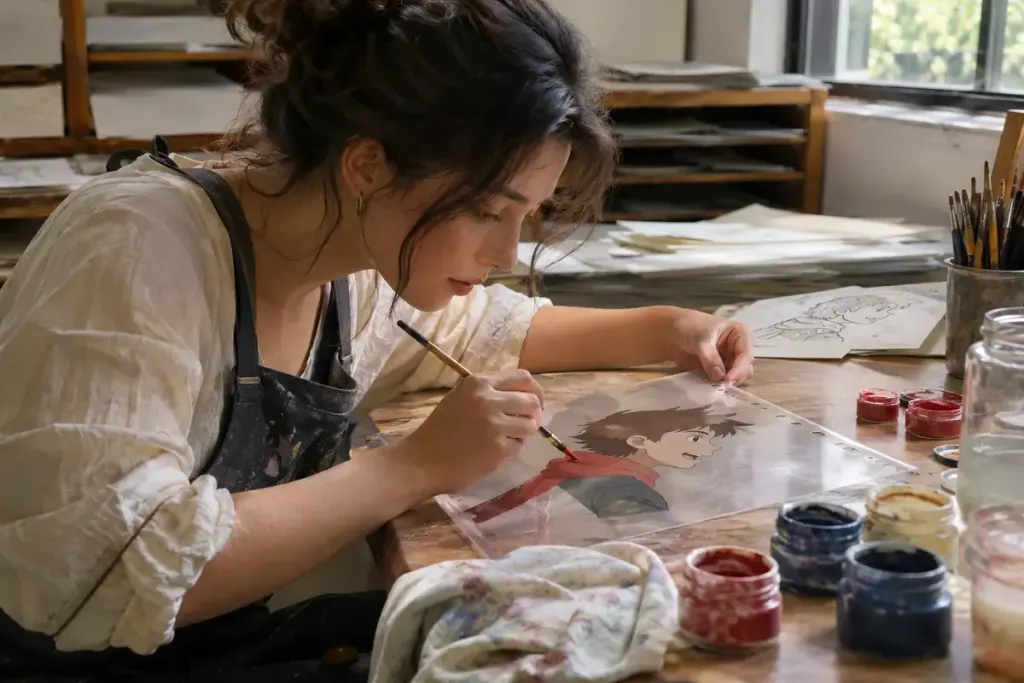
A traditional animation cel can look tidy from the front while showing broad areas of paint on the back. That difference is intentional: colour is often applied to the reverse of the transparent support.
The Walt Disney Family Museum’s guide to displaying animation artwork describes cels as paint applied to the back of a clear substrate. The transparent sheet allows the coloured character or object to sit over a separately prepared background.
Think in layers
Imagine a simple character with a dark outline and a red coat. The viewer sees the linework and the coat colour through or across the clear sheet, while the paint’s working surface is on the reverse. Areas left transparent allow the background to show through.
That arrangement helps separate tasks and makes it possible to photograph changing character artwork over a background. The exact materials and production methods varied across studios and periods, so a modern digital animation should not be assumed to contain physical cels at all.
For a viewing exercise, find an authorised museum image of a cel and its background. Identify which parts belong to the transparent layer and which belong to the painted scene beneath it. Then consider how a moving arm could change while the room remains the same.
Handle original artwork cautiously. Ageing plastic and paint can be fragile, and reverse painting creates conservation problems that are not solved by applying household adhesive. A collector should seek specialist advice rather than trying to press loose paint back into place.
The reverse side can reveal the labour behind a clean screen image, but it is not a rough version waiting to be corrected. It is part of a production object designed to be viewed and photographed from a particular direction, with several layers cooperating to create the finished frame.