
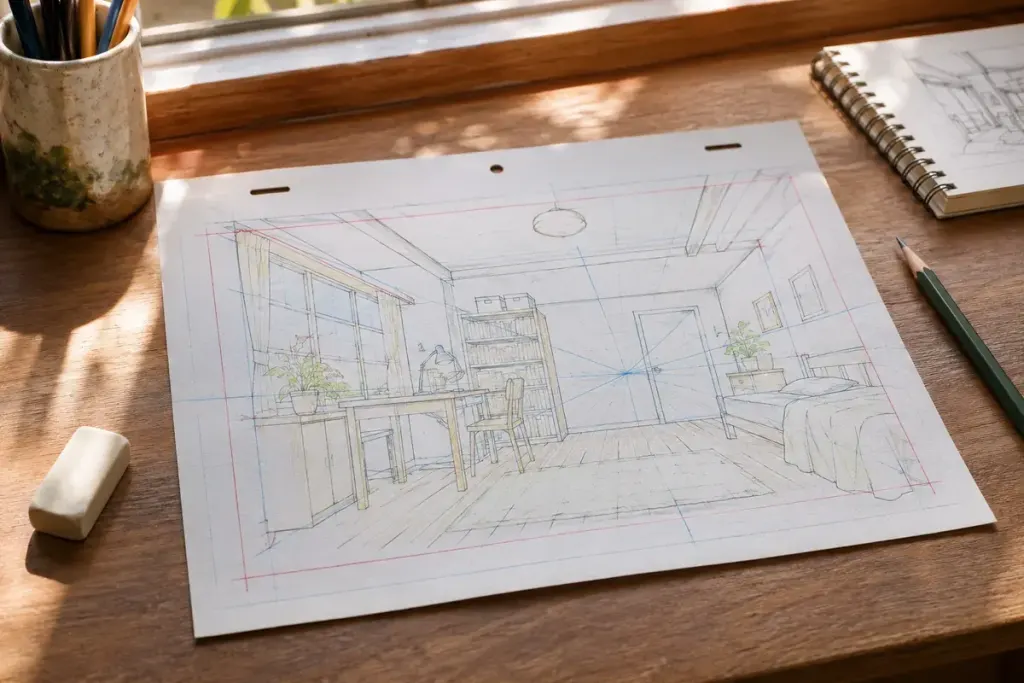
An anime scene can feel spacious, cramped or imposing before a character says anything. Much of that impression depends on where the characters, background and viewpoint are placed. A layout drawing helps establish those relationships for an individual shot.
Studio Ghibli’s explanation of its layout exhibition describes layouts as a kind of film blueprint, including background and character positions, movement instructions, camera work and photographic treatment. This is production information, not merely a less polished version of the finished picture.
Look for decisions hidden in the sketch
Start with the viewpoint: are we looking down, up or straight across the room? Then compare the character’s scale with doors, furniture and foreground objects. Finally, notice the space left for movement. These choices influence how the shot can unfold.
Imagine an original scene in which a child enters a very large library. A low viewpoint, a small figure and shelves extending upward could make the room feel overwhelming. A closer layout at eye level could make the same room feel familiar. The plot has not changed, but the viewer’s relationship to the space has.
Distinguish the stages
A storyboard helps organise the sequence and intended action across shots. A layout develops the spatial and compositional arrangement of a particular shot. Background art, animation and later production stages build on those decisions, although workflows vary between studios and projects.
That is why a layout may include arrows, guides or annotations that never appear on screen. They communicate a task to another member of the production team. Judging them only as gallery drawings misses that practical role.
A viewing exercise without copying a studio drawing
Pause a scene you are studying privately and sketch only large shapes: the frame, floor line, a few objects and the character’s position. Then imagine moving the viewpoint higher. Write one sentence about how the emotional impression changes.
Use your own invented setting if you want to share the exercise publicly. The goal is to understand composition, not reproduce proprietary production artwork.
Layouts reward attention because they reveal how apparently effortless space is constructed. The finished animation may move quickly, but the arrangement beneath it contains deliberate choices worth slowing down to notice.