
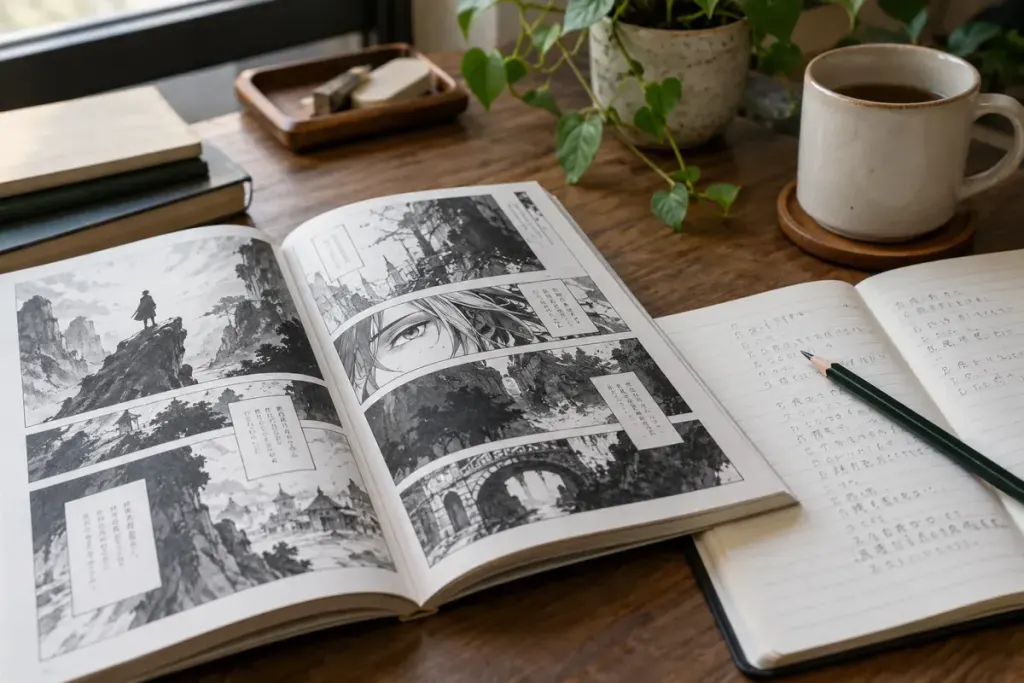
In a Japanese manga panel, small characters may sit beside or above larger kanji. These reading guides are easy to overlook when your attention is on the artwork, but they can affect how the written dialogue is understood or spoken.
Separate the main writing from the reading guide
Furigana commonly provide a pronunciation guide for kanji. For a learner, they can make an unfamiliar written word pronounceable without immediately explaining its meaning. Recognising the sounds and understanding the word are related tasks, but they are not identical.
The Japan Foundation’s Irodori learning guidance discusses reading material without furigana and checking unfamiliar words and readings. That distinction is useful when moving between learning resources and ordinary published material.
Notice when the two layers do different work
In creative writing, a reading guide can sometimes indicate a chosen pronunciation that adds a separate nuance to the main characters. Do not assume every small annotation is merely a dictionary reading. Examine the surrounding dialogue and, if necessary, consult a reliable explanation of that specific passage.
A translation may need to choose between preserving the spoken wording, the written implication or explaining both. That does not automatically make a difference between editions an error. Look at the translator’s notes and the publisher’s presentation before drawing a conclusion from one isolated panel.
Try a small comparison exercise
Choose a short passage from a legally obtained edition. Record the main word, its reading guide and your understanding of the sentence. Then compare an authorised translation if you have one. Note what you can establish and what remains uncertain.
Avoid building a sweeping claim about a character from an unfamiliar annotation alone. Paying attention to the lettering can enrich a reading, but the surrounding scene still supplies the context that makes the detail meaningful.