
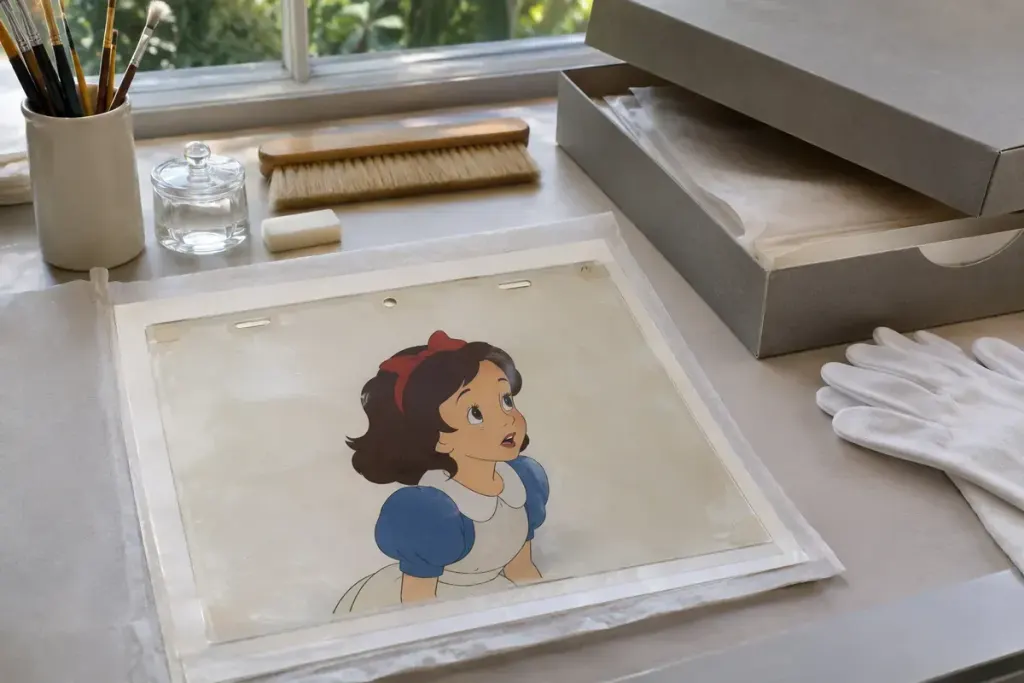
An animation cel can preserve a tiny piece of a film’s production: painted artwork on a transparent sheet, once combined with other layers to make a frame. Owning that object is different from owning a printed poster. Its materials can age in ways that a decorative frame does not solve.
The Getty Conservation Institute’s collaboration with Disney’s Animation Research Library investigated both the plastic supports and paint layers, with storage conditions central to preservation. It shows why there is no single household trick that safely treats every old cel.
Document before intervening
Record what you know about the object: its claimed production, seller, date of purchase and any accompanying drawing or background. Photograph its condition without bending the sheet or separating layers that have stuck together.
Keep provenance and condition as separate questions. A plausible production history does not establish that the plastic is stable, while an attractive surface does not prove that an object is an original production cel.
Ask about the whole housing arrangement
Before framing, consult a conservator familiar with animation materials. Explain whether the goal is occasional viewing, storage or display. Ask how the support, paint, enclosure and environmental conditions should be considered together.
A published conservation study on reattaching loose cel paint describes specialist research, not a repair procedure to imitate with domestic glue. Flaking paint, distortion or adhesion between layers is a reason to stop handling and seek advice.
For a practical collection record, note where the cel is kept and any observed change, with dated photographs taken consistently. Avoid repeatedly lifting it just to check whether a flaw has worsened.
A display copy may let you enjoy the image while keeping the original under an appropriate storage plan. The decision depends on the object and professional advice. The important shift is to treat the cel as a vulnerable material record of animation work, rather than assuming that putting it behind glass completes its care.