
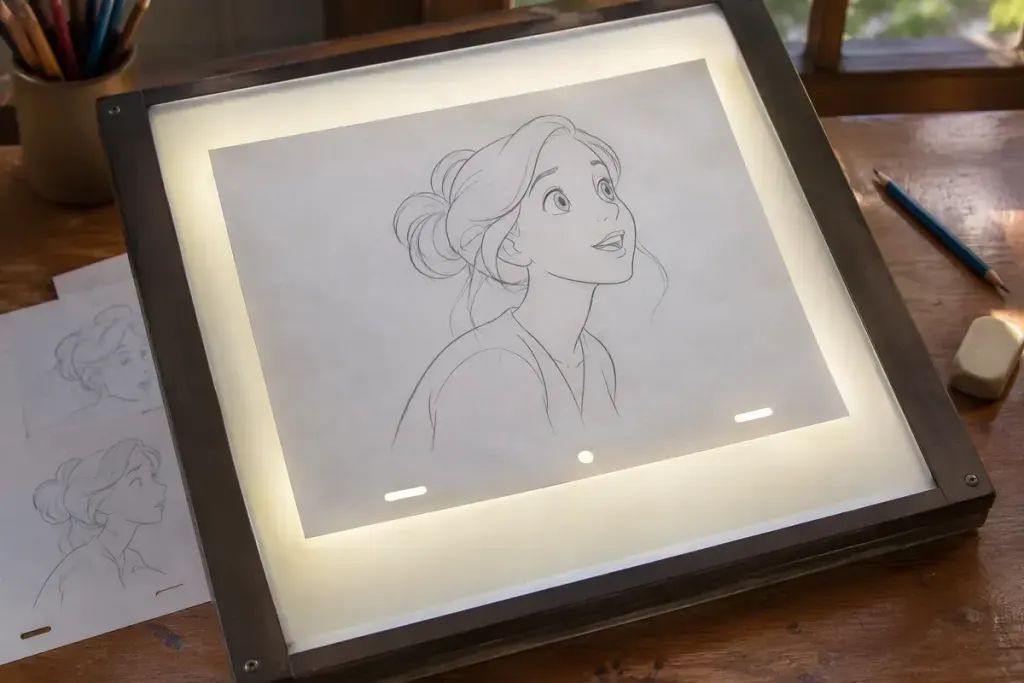
A clean pencil drawing from an anime production may be labelled douga. It is tempting to translate that simply as “an in-between,” but the production term can include more than a newly inserted pose.
Production I.G’s explanation of douga describes both cleaning up key drawings and creating drawings between them. The clean-up preserves the intended character and movement while preparing consistent lines for the following production stages.
A finished line still carries a performance
Compare a rough key drawing with its cleaned counterpart when a studio publishes both. The rough sheet may contain construction lines or several searching strokes where the finished drawing needs a clear contour. Notice which line defines the cheek, sleeve or hand, and how the clean version keeps the original intention.
Clean-up also involves judgement. A slightly different eye line or shoulder contour can alter a character’s expression. The task is not merely to make a rough drawing look tidy in isolation.
Read the sheet with its companions
A loose production drawing tells only part of the story. A sequence, timing information and the related key drawings can explain how it was meant to be shown. Do not infer a scene’s frame rate or the total number of drawings from one sheet.
Toei Animation’s production overview places douga between key animation and colouring in its illustrated workflow. That gives a useful orientation, while individual studios and projects may organise tools and responsibilities differently.
Try a viewing exercise
Choose a short officially available production demonstration. Watch the action at normal speed, then study the drawings used to build it. Notice where spacing changes and which lines must remain consistent to keep the character recognisable.
If you collect artwork, keep the seller’s description and provenance separate from your own visual observations. A clean line does not by itself prove a drawing’s production role or authenticity.
Understanding douga makes the labour between striking key poses more visible. The viewer experiences a continuous action, but that continuity depends on many specific decisions about line, timing and movement.