
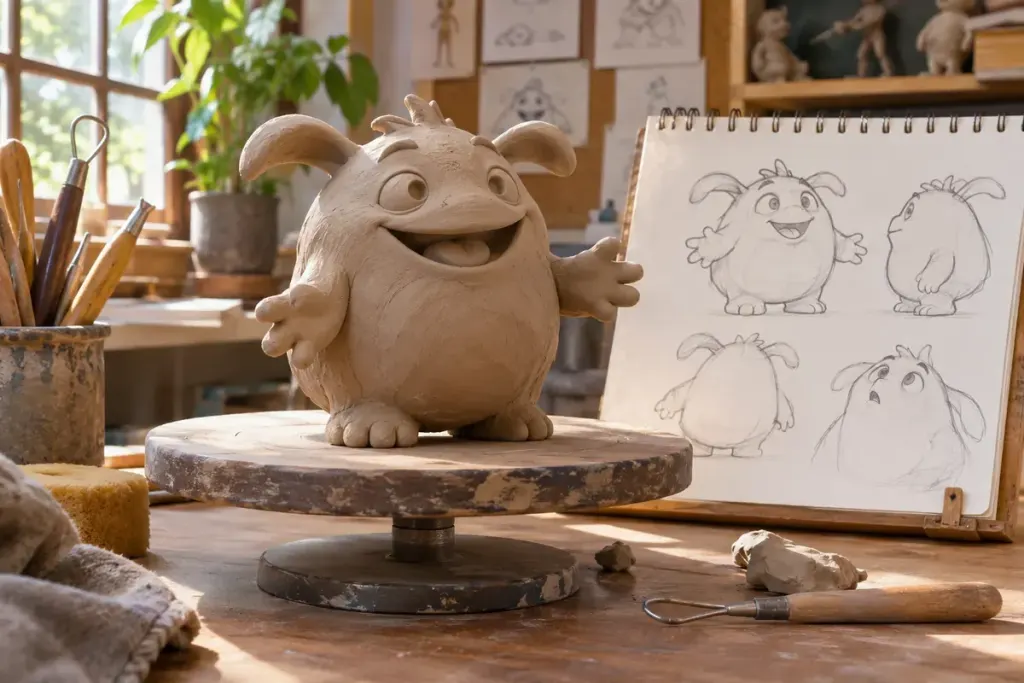
A small character sculpture in an animation exhibition may have been a working reference rather than merchandise. A maquette lets artists inspect a design as a three-dimensional form, including views that a single drawing leaves unresolved.
The Walt Disney Family Museum’s account of a Pinocchio maquette explains how character models helped animators visualise figures from different angles. Its historical example belongs to a particular production process; it does not establish that every animation studio uses the same materials or workflow.
Follow the silhouette around the figure
Start with the front view, then look at a three-quarter angle and the profile where an exhibition permits it. Notice what happens to the nose, cheeks, ears, and spaces between limbs. A shape that reads clearly from one direction can become crowded from another.
As an original drawing exercise, make a simple character from a few pieces of modelling clay suitable for your use. Sketch it from three positions without changing the model. Compare the outline and overlapping forms. The aim is not to produce a polished collectible; it is to discover which parts of your imagined design were never fully decided.
A sculpture still does not settle every drawing choice. An animator may simplify, exaggerate, or adjust a pose for the camera and the action. The model offers a spatial reference, while the shot still needs a readable performance.
Ask what kind of object you are seeing
Read the exhibition label for the date, material, maker, and connection to production. A later commemorative cast and a model used during development can look similar while having different histories. Do not infer production use from the character’s recognisable face alone.
Historical maquettes can be fragile. The museum’s conservation account describes deterioration and treatment of its object, so looking closely should never become touching without permission.
For a useful exhibition note, describe one relationship that became clearer in three dimensions: how a head sits over the shoulders, how a muzzle projects, or how an arm clears the torso. That observation connects the small sculpture to the practical work of making a character convincing on screen.