
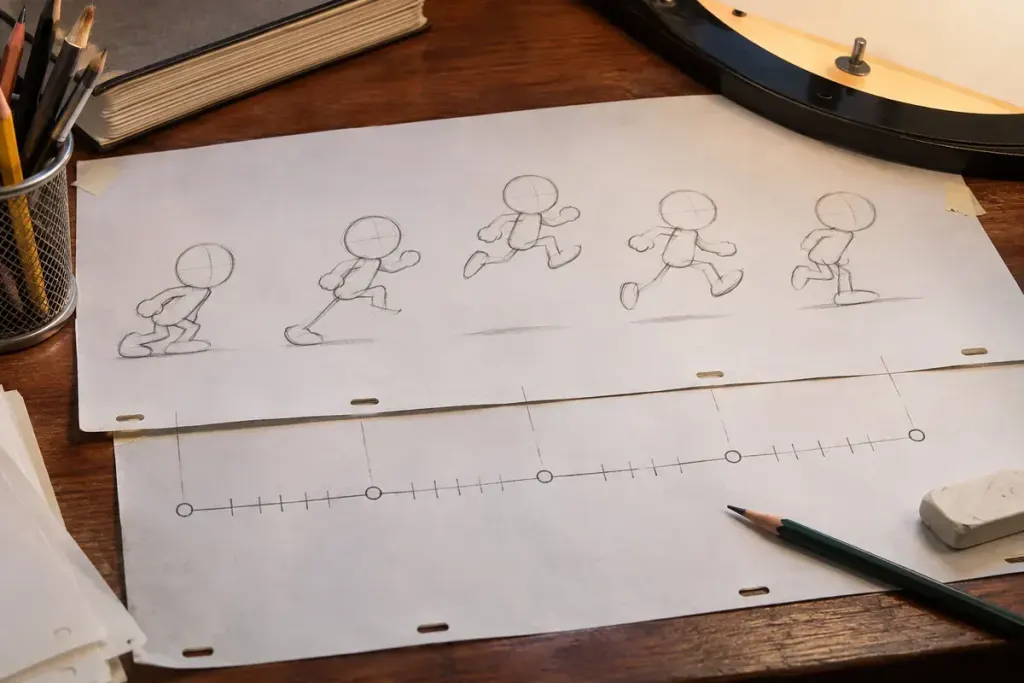
A timing chart beside an animation drawing is a set of instructions for another artist. Its marks help preserve decisions that might disappear if an inbetweener were given only two poses and asked to fill the gap.
The Disney Animation paper BetweenIT: An Interactive Tool for Tight Inbetweening describes charts that specify the number and intervals of drawings between keys. Toon Boom’s timing-chart activity places them alongside key-pose planning. The chart is communication within a workflow, not a decorative annotation added after the motion is finished.
Follow the instruction back to its drawing
When studying a production sheet, first identify which key drawings the chart connects. Then check what its numbers denote in that workflow. A drawing identifier, a frame number and a position on the chart are not interchangeable merely because each can be written as a numeral.
Look next for a breakdown drawing: an intermediate pose that helps define how the action travels between keys. A raised hand might follow an arc or turn in depth. The endpoints alone do not explain that path, so the breakdown and any written notes remain important even when the chart looks precise.
A handoff check for an original exercise
Draw a simple character reaching for a cup and prepare a small handoff packet: the labelled keys, any necessary breakdown, the chart and the exposure information. Give the packet to a collaborator without explaining the movement aloud. Ask them to point out every instruction they cannot interpret confidently.
Do they know which drawing comes first? Can they match the chart to the intended pair of keys? Is a note about the hand’s arc visible beside the relevant drawing, or buried on another page? These questions test the clarity of the handoff rather than the beauty of the poses.
Revise ambiguous labels before adding more drawings. Keep a short version note when a key changes, since an old chart attached to a revised pose can communicate the wrong intention perfectly clearly.
Studying charts this way reveals an often overlooked part of animation: artists are designing instructions for one another as well as images for an audience.