
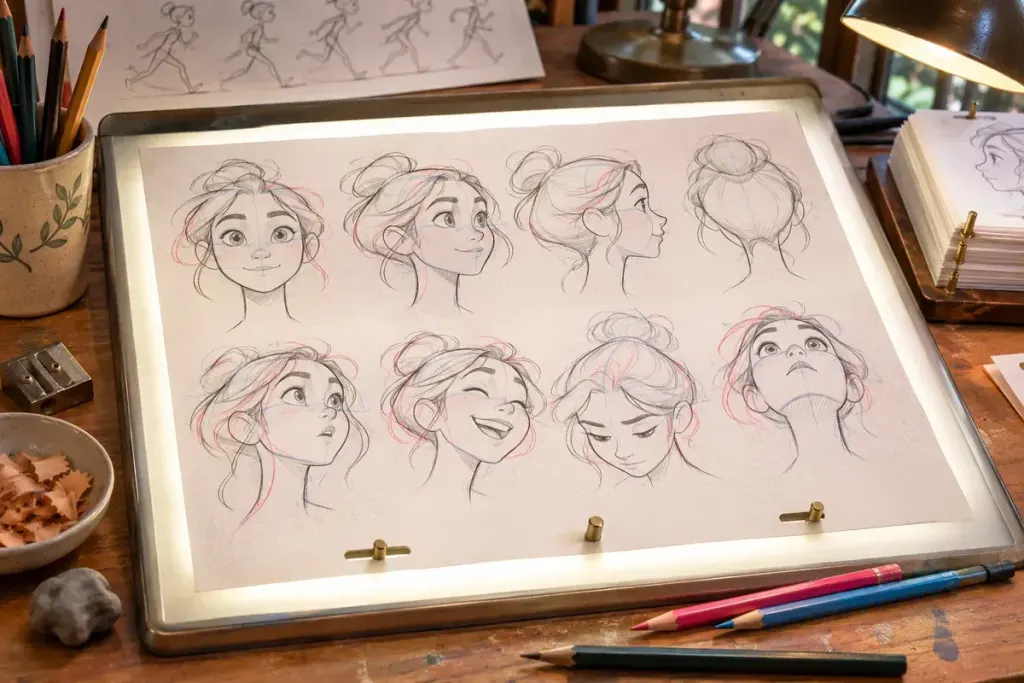
A character can be drawn by many artists across an episode and still feel like the same person. That consistency is partly the work of animation directors, who review drawings and make corrections within a production’s chosen visual approach.
In Otsu Animation’s interview with its chief animation director, the discussion connects the role with drawing quality, layouts and character consistency. It offers a practitioner’s account of the work, rather than suggesting that one job title describes every studio’s workflow identically.
“On model” is more than matching a face outline
For a viewing exercise, follow one character through a quiet conversation. Notice the relationship between the eyes, nose, jaw and hair silhouette as the head turns. The drawing changes with the angle, but the design can remain recognisable.
Then compare an exaggerated reaction in the same episode. A stretched face or simplified expression may be deliberate performance, not a lapse that somebody failed to correct. Consistency does not require every drawing to look like a neutral reference-sheet pose.
This distinction is useful when looking at production materials released by a studio. A correction can clarify an intended volume, expression or pose while preserving the movement. It need not mean the earlier animator lacked skill or that the final image was produced by one person alone.
Read credits as evidence, not a diagnosis
Credits identify contributions, but they do not reveal every scheduling decision or revision. Avoid inferring a troubled production solely from a long list of animation directors, and do not assign an individual artist responsibility for an isolated frame without evidence.
Watch the scene in motion before judging a paused image. Transitional drawings can look unusual when separated from the movement they support. If you want to compare episodes, choose similar kinds of scenes and describe what you actually see: a sharper jaw, a different eye shape or a broader expression.
That approach turns the credit into a useful question about craft. It invites closer watching while leaving room for the many artists and production decisions behind the finished performance.