
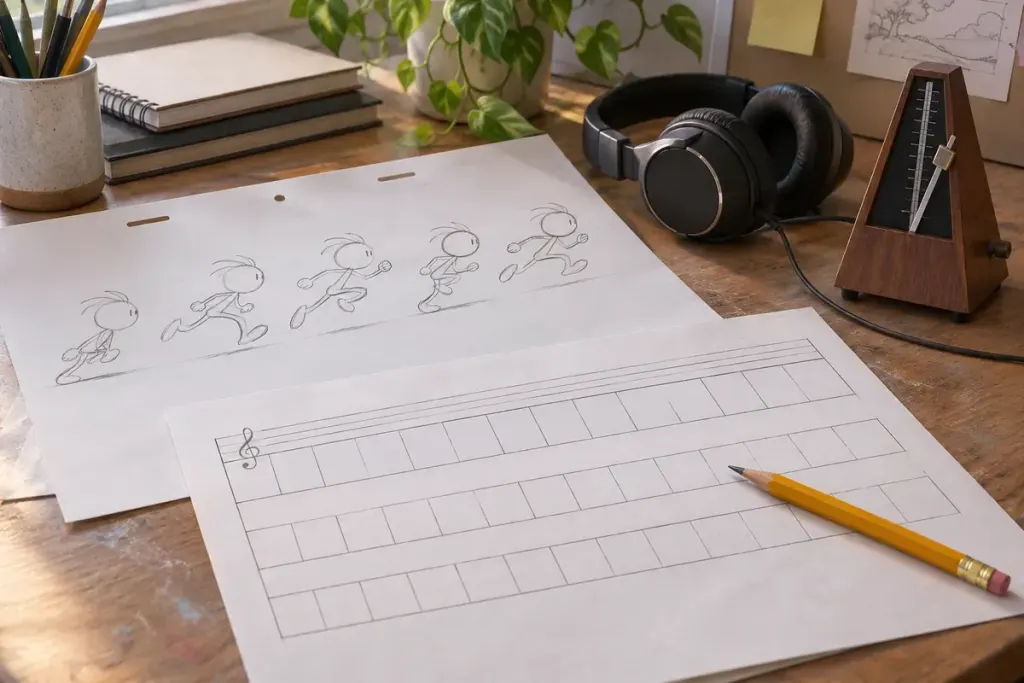
A character’s movement can arrive exactly on a musical accent because that relationship was planned before the drawings were finished. A bar sheet organizes action against musical measures and beats, giving animation and music a shared timing reference.
David Shepstone’s research on sound and musical timing in animation, published through IADT, discusses bar sheets in early synchronized animation production. The historical tool helps explain a planning principle; it does not mean every modern anime production uses the same paper format.
Turn one beat into a frame interval
Use a deliberately simple exercise: an animation running at 24 frames per second and music at a steady 120 beats per minute. There are two beats each second, so each beat spans 12 frames. A four-beat measure spans 48 frames under those assumptions.
Draw four beat boxes and mark an action you want to land on each beat. For example, a ball might contact the floor on the first beat, reach its next peak between beats, and arrive at another planned contact later. The sheet identifies timing targets; it does not decide every in-between drawing.
Synchronize selectively
Try a version with a major movement on every beat, then another with only a few accents matched. The first may feel emphatic or comic; the second can leave more room for the character’s movement to breathe. Those are creative choices to judge by watching and listening together.
Keep the frame rate and musical tempo written beside the exercise. A tempo change or a different playback rate invalidates a simple fixed frames-per-beat calculation. Use an original rhythm or audio you have permission to work with.
An exposure sheet may give detailed drawing and camera instructions, while a bar sheet emphasizes the musical structure. Understanding their different purposes makes a tightly synchronized sequence more interesting to watch: the apparent spontaneity can rest on a carefully planned meeting of two timelines.