
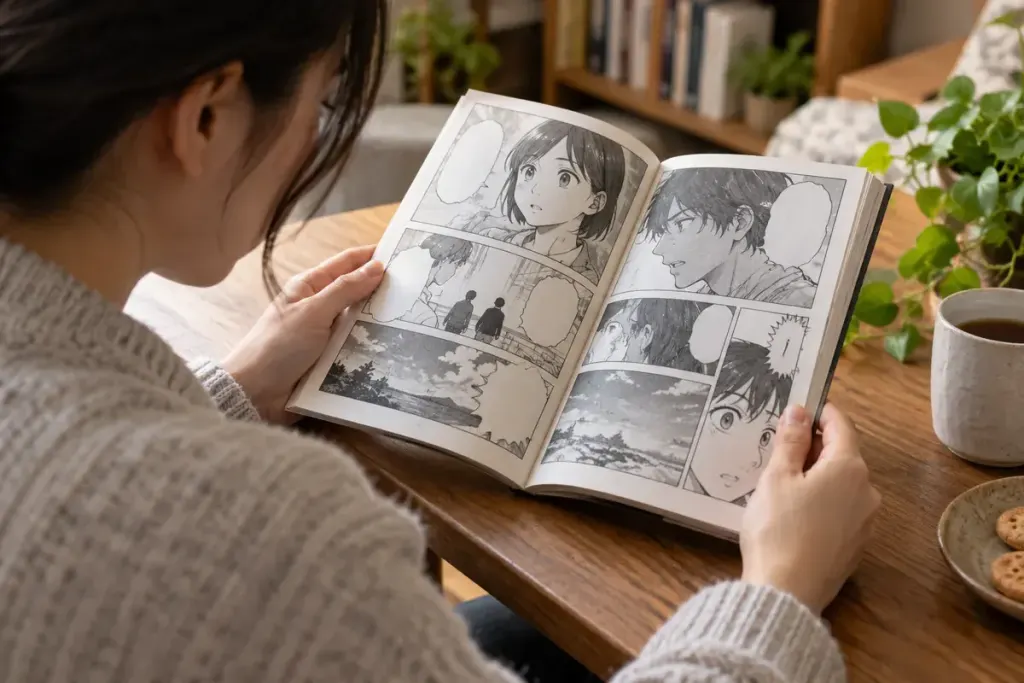
A line of dialogue appears beside two characters. You assign it to the nearer face, then the next panel stops making sense. Before deciding the translation is wrong, look again at the balloon and the route your eye took through the page.
Manga dialogue belongs to a visual sequence. Balloon placement, tails, panel boundaries and lettering can all contribute to how you identify a voice. No single cue works as a universal rule across every artist or edition.
Read the tail, then the scene
Trace a balloon’s tail where one is present. Does it indicate an on-panel character, someone outside the frame or a direction that the next panel clarifies? A balloon without a conventional tail may need surrounding context rather than an immediate attribution.
Consider an invented scene: a character stands in a doorway while another remains off-panel. The nearest visible face is not necessarily the speaker. The response in the following panel may reveal who asked the question.
Distinguish dialogue from other text
A narration box, thought, sound effect and spoken line can occupy the same page. Look for the visual conventions established by that particular work. A change in border or lettering may signal a different kind of text, but avoid turning one artist’s convention into a rule for all manga.
Check the reading direction of the edition too. Do not assume a digital viewer has arranged every spread exactly as the printed book does. If a two-page composition feels confusing, use the publisher’s intended view where available and inspect the page as a whole.
For a reading note, mark uncertain attribution with a question mark instead of silently building later interpretation on it. Return after the scene is complete. Sometimes the ambiguity is deliberate; sometimes you simply skipped a balloon.
This kind of rereading can make a quiet conversation more interesting. The page is not merely carrying words between pictures. Its arrangement controls when you hear a voice, when you recognise it and when a reply changes the meaning of what came before.