
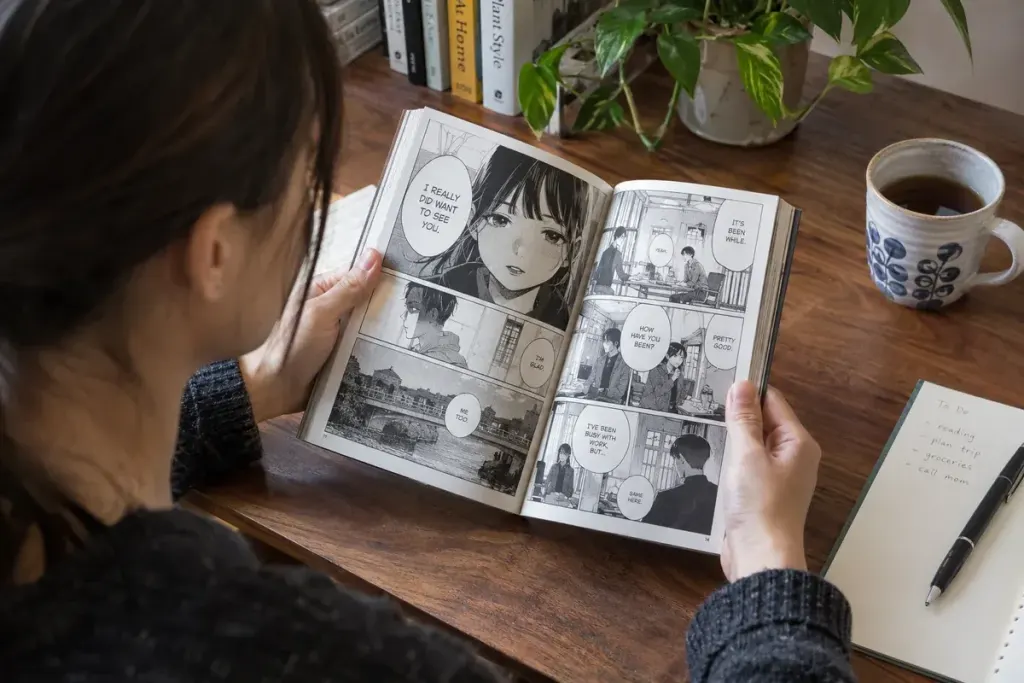
A manga scene can feel fast even though nothing on the page moves. Another can hold you in a quiet moment with only a few lines of dialogue. Part of that effect comes from what happens between panels: the reader connects separate images into a sequence.
Choose a short scene you already know so that plot surprises do not distract you. Follow the edition’s reading direction and notice where your eye goes first. Then ask what guides it toward the next image: a face, a movement, a speech balloon or the shape of the layout.
Look for the change between images
Two neighbouring panels might show different moments, different viewpoints or a reaction to something outside the frame. The gap does not always represent the same amount of time. A repeated view can make a pause noticeable; a large change can ask the reader to infer what happened in between.
Clip Studio’s guide to comic and manga layouts discusses page flow from a creator’s perspective. Reading with that question in mind can reveal how a page leads attention without needing to copy or reproduce the artwork.
Separate a useful observation from a rule
It is tempting to say that large panels always slow a scene or that many small panels always make it fast. Actual reading depends on the amount of text, visual detail, repetition and context. Instead of applying a formula, describe the effect on the specific page.
Try writing three short notes: “I paused here,” “I had to look back here,” and “the next page changed my understanding.” Then identify the visual feature associated with each response. This keeps the discussion grounded in the reading experience rather than vague praise for the art.
- Notice where dialogue begins and ends.
- Check which reaction receives its own panel.
- Look at what is withheld until a page turn.
- Compare a quiet scene with an action sequence.
If you discuss the scene with someone else, allow for different reading speeds and interpretations. Use chapter or page references appropriate to the edition and warn about spoilers. The point is not to find one correct stopwatch for a comic. It is to notice how the arrangement of still images gives a story rhythm.