
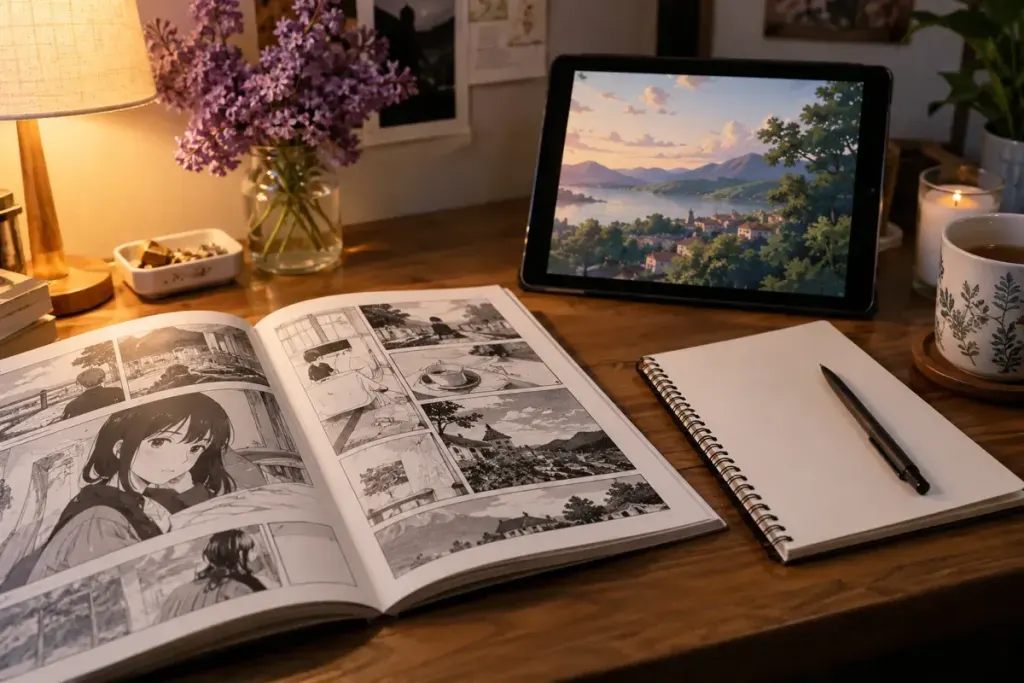
After reading a manga and watching its anime, it is tempting to make a list of everything that changed. The list can be accurate and still miss the most interesting question: what does each version make you notice or feel at that moment?
Comparing adaptations becomes more rewarding when you choose a small scene and examine the choices of the medium. You do not have to decide that one version wins before the discussion can begin.
Choose a scene with a clear purpose
Pick a conversation, arrival or turning point you can revisit without needing to summarise the entire story. Decide whether your notes will include spoilers, and state that clearly when sharing them. Use legitimate copies or authorised services available in your region.
Write down what the scene needs to communicate. Perhaps a character learns something, trust changes or the audience notices a detail before the protagonist does. That gives the comparison a focus beyond whether every line was retained.
Notice who controls the time
On a page, you can pause, scan backwards or move quickly through several panels. On screen, editing, movement and the duration of a shot shape the first viewing’s rhythm. Rather than counting omitted panels, ask which beat the adaptation gives time to and which it passes over.
In a fictional example, a manga might place a tiny reaction panel after a long speech. An animated version could hold on that reaction in silence. Both can draw attention to hesitation, but they do so with different timing. This is an invented analytical example, not a description of a particular production.
Listen to what the page cannot play
Consider voice performance, music and environmental sound. Does the soundtrack reinforce an emotion, complicate it or leave the moment deliberately quiet? Compare that with the page’s lettering, composition and visual cues without assuming that adding sound automatically improves a scene.
For broader context, the BFI’s selection of anime films discusses films with varied styles and adaptation backgrounds, including Tekkonkinkreet’s relationship to Taiyo Matsumoto’s manga. It offers examples to explore rather than a universal rule for how adaptation should work.
Separate observation from preference
An observation identifies a choice: the scene begins later, a reaction is held longer or the viewpoint changes. A preference describes your response to it. Keeping both visible makes an argument easier to discuss than saying that a version is simply more faithful or more emotional.
Try a three-line note: what changed, what effect it had for you and what detail supports that reading. Another viewer may interpret the same pause differently. A useful comparison gives them enough evidence to explain why.
End with a question worth revisiting
Ask what you noticed in the second version that you missed in the first. Did a performance clarify a relationship? Did returning to the page reveal background detail that passed quickly on screen? These questions reward revisiting the work.
If you are still choosing a manga edition, our edition guide helps identify the right volume and format. Once you have the right material, a focused comparison can deepen enjoyment without turning every difference into a fault.