
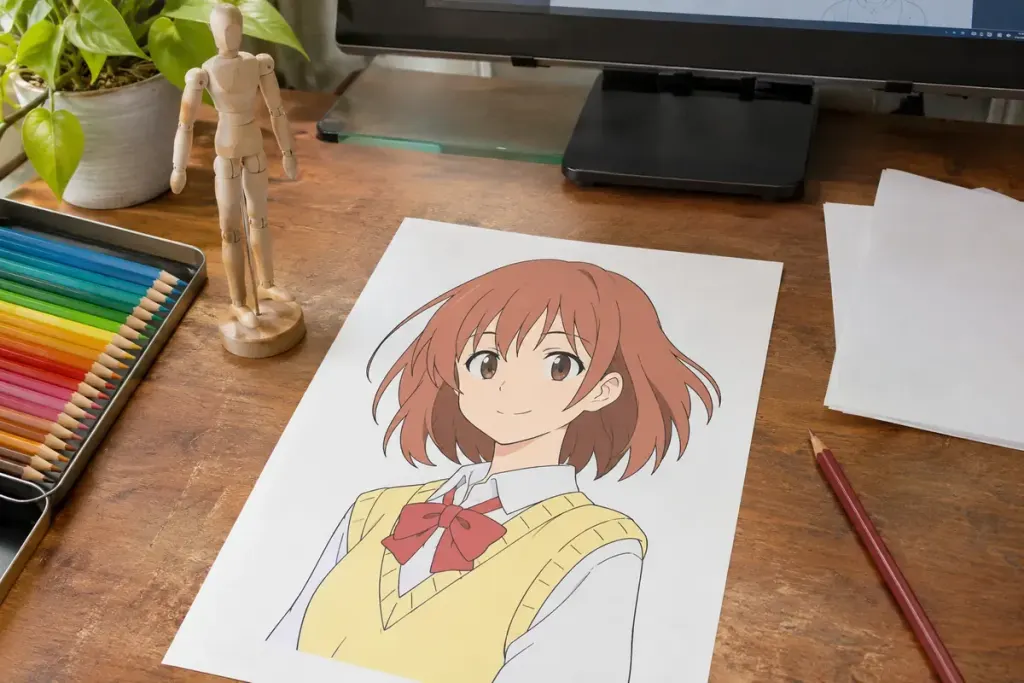
A character can feel solid, expressive and present in a scene without a dark wedge beneath every strand of hair. In a relatively shadowless design, the outline and the boundaries between colours do more of the work we might expect from shaded modelling. Looking for those choices makes a seemingly simple drawing much more interesting.
This is a real production decision, rather than a rule that all anime follows. In VFX Voice’s interview about Scarlet, compositing director Akiko Saito discusses the comparatively shadowless appearance of earlier Studio Chizu work and the different treatment developed for this film. The discussion also shows why a studio label alone cannot describe every sequence’s look.
Try a three-frame comparison
- Pause on a clear view of a face. Follow the outer contour before examining the eyes or mouth.
- Move to a frame where the character turns. Notice which lines change and which areas remain a single colour.
- Watch the movement again at normal speed. Ask whether the turn reads clearly without adding imaginary shadows.
This is a viewing exercise, not a way to score the animation. A still frame can make an economical design appear empty because it removes timing, the neighbouring drawings and the background relationship. Motion restores those parts of the decision.
Separate character shading from the whole scene
A lightly shaded face may appear against a richly textured landscape. A flat-coloured costume can still have a carefully chosen silhouette. Likewise, a scene described as shadowless may contain cast shadows or selective accents. The useful question is where visual detail has been concentrated, rather than whether you can find a single dark patch.
Next time a quiet conversation holds your attention, watch the shoulder line and the spacing around the characters. Their separation from the background, the turn of a head and the timing of a glance may explain the scene’s clarity better than counting how many shades were painted onto a cheek.