
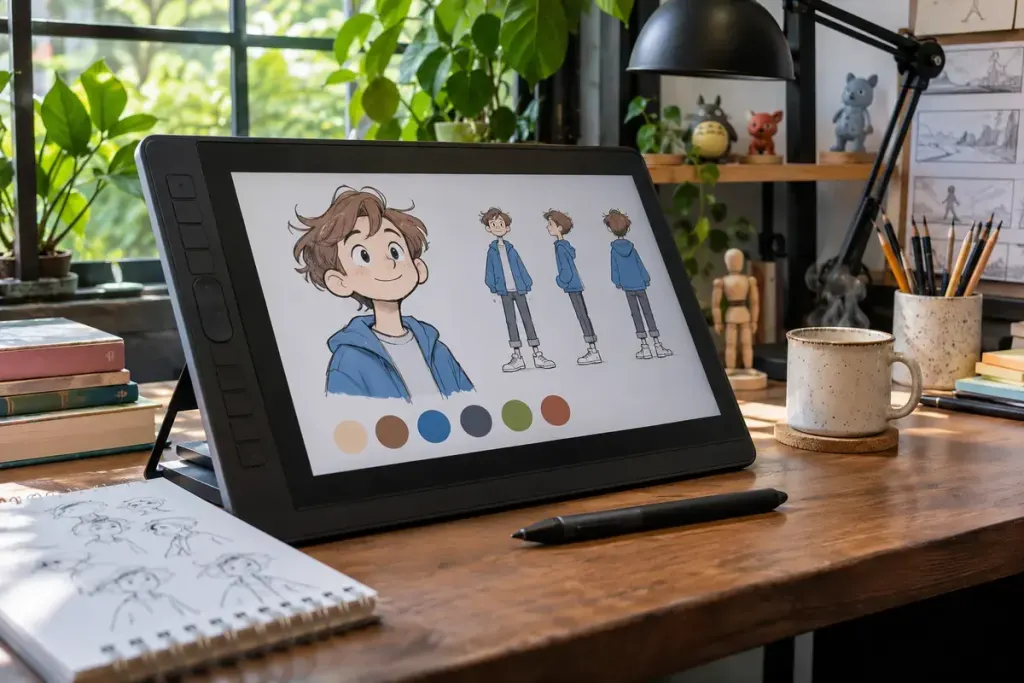
A character’s jacket may look like the same blue in dozens of drawings. In an indexed animation workflow, that consistency can come from the drawings referring to a palette style, rather than each painted area storing an unrelated choice of blue.
The style’s index acts as a connection. Change the colour defined by that style and the drawings using it can update together. That is a different operation from selecting every blue-looking pixel in a finished image.
The OpenToonz palette documentation explains this for Toonz Vector and Toonz Raster levels. It also distinguishes ordinary Raster levels, where painted pixels do not retain the same link to a palette style. The type of level matters before expecting a global colour change.
Imagine a jacket and a bag that happen to share a colour in an early design. If both use one style, changing that style changes both. Separate styles can preserve independent control even when their current colour values are identical.
Useful names might describe the object and lighting role, such as jacket base and jacket shadow. The names help people understand the intention; the underlying style references make the connection work.
For a small practice scene, create several drawings using two clearly named styles. Edit one style, then inspect every drawing. This reveals the difference between a deliberate shared colour and an accidental reuse.
A revised colour may look right on the current drawing but expose a mistaken style assignment elsewhere. Scrub the sequence, inspect overlaps and look for a fill that changes unexpectedly.
Keep the palette and relevant level files saved together according to the software’s workflow. A screenshot of the palette is useful as a visual reference, but it does not preserve the editable relationships inside the project.
When watching anime, a consistent costume colour can appear effortless. Looking at palette IDs reveals one practical part of that consistency: colour is organised as reusable information. The system saves repeated painting work only when the original assignments are clear and the changes are checked across the drawings that depend on them.