
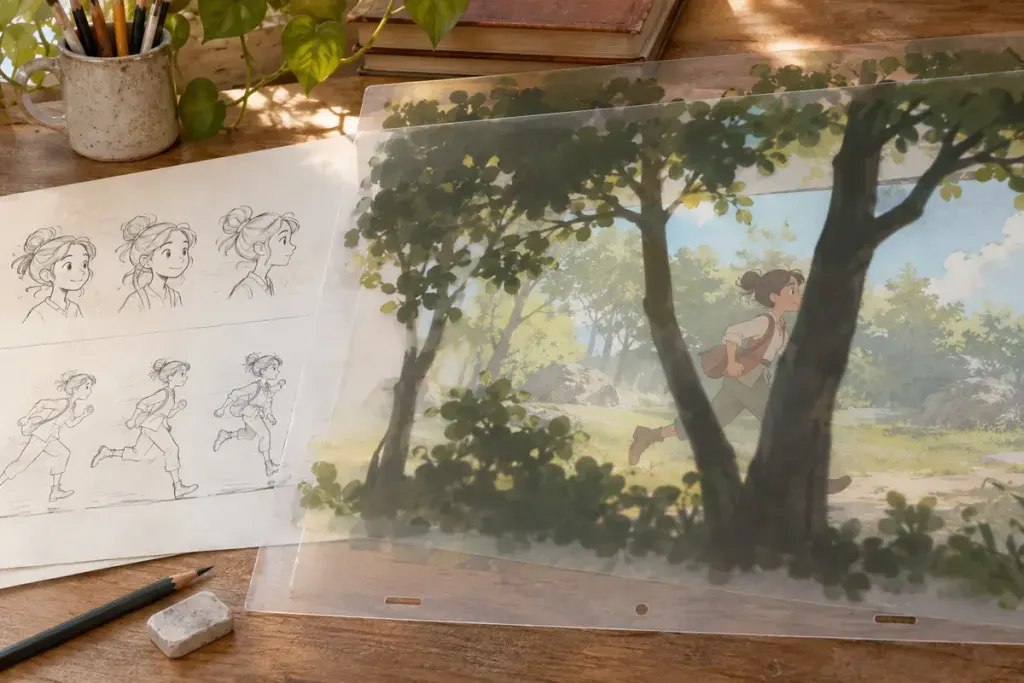
A character walking across a painted room can look as though they are sliding over a postcard. Let the character pass behind the edge of a chair or a hanging plant, and the room suddenly feels more occupied. The foreground object provides an overlap cue: part of the figure is hidden for a moment.
Animation production often separates artwork into layers. Toon Boom Harmony’s layer guide describes background and overlay naming among traditional conventions. An overlay can sit in front of character artwork, although the exact organisation depends on the production and compositing setup.
Build a doorway with three pieces
For a small exercise, draw a room on the bottom layer, a character on a middle layer and a doorframe edge on the top layer. Move the character horizontally. When the figure crosses the doorframe, the frame should conceal the appropriate part of the body without changing the character drawing.
Now move the frame below the character layer. The same shapes produce a different spatial reading: the character appears in front of the frame. This change comes from the stacking order, not from a more detailed background or a more realistic drawing.
Try three checks before adding polish:
- Does the overlap begin where the character enters the doorway?
- Is the foreground shape large enough to read clearly?
- Does it hide an important gesture or facial expression at the wrong moment?
A convincing layer arrangement also needs consistent shadows, scale and movement. An overlay cannot fix a walk cycle that travels at the wrong speed. It simply supplies one useful relationship between the figure and its surroundings.
When watching a scene, look for brief interruptions to a silhouette: a shoulder passing behind foliage, feet disappearing behind furniture, or a face crossing a window edge. These small overlaps can make a setting feel tangible. In your own shot, use them where they clarify the staging rather than placing foreground decoration across every piece of action.