
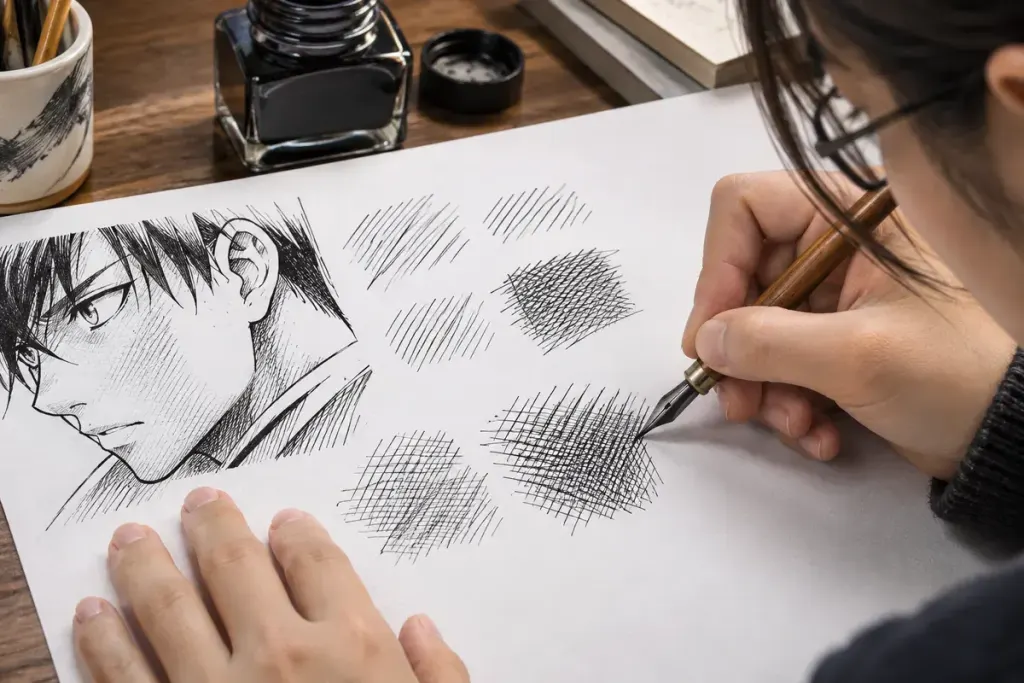
A shaded area in manga may be built from hundreds of small strokes rather than a smooth grey fill. Look closely and you can see groups of lines crossing at different angles, creating tone while preserving a visible hand-made rhythm.
Kakeami is a term used for crosshatching in Japanese manga. Artist Yukinoco’s Clip Studio tutorial on pattern brushes and kakeami demonstrates combining hatching with natural textures. The digital method is one application of the mark-making idea, not a requirement to buy or use a particular brush.
Read the direction as well as the darkness
Closer or overlapping strokes can make a patch appear darker, but the direction and grouping also affect its character. A surface may feel rough, soft or restless because of the way marks change across it. That is different from assuming every line follows the physical grain of the object.
When reading a page, compare a dark hatch area with a solid black shape nearby. Ask which one attracts attention and how each relates to the character’s face or the main action. There is no single correct emotional meaning attached to a texture.
A three-patch exercise
On scrap paper, draw three small squares. Fill the first with one group of parallel strokes. Add a second direction in the next square. In the third, vary the spacing while keeping the pen and paper the same. Let the ink dry before handling the page.
Step back to normal reading distance. The marks that looked separate close up may merge into a tone. Note where the texture remains readable and where it becomes visually crowded.
Check the final size
If you draw digitally, inspect the work at the intended output size as well as zoomed in. A detailed pattern can behave differently after reduction or printing. Keep an original file so a texture adjustment does not require rebuilding the whole panel.
Use published pages to study decisions, not to trace and republish another artist’s work. Your own small texture tests can teach the same practical lesson: shading is not only about making an area darker, but about choosing the marks through which that darkness is seen.