
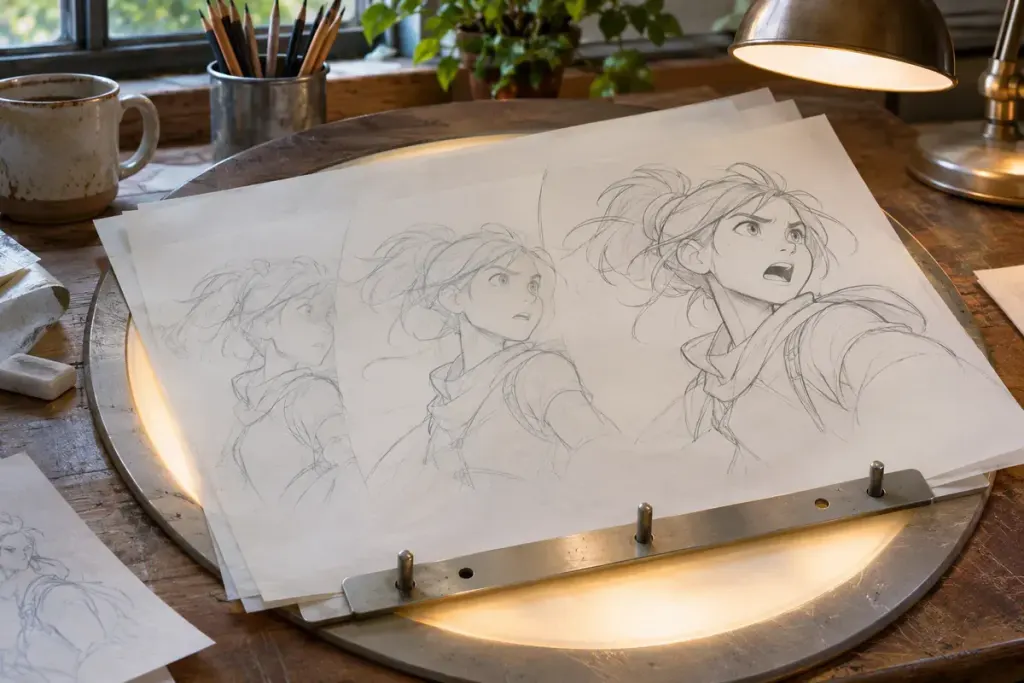
A drawing in an animation exhibition may look familiar because it resembles a moment in the finished film. Looking only for that recognisable pose, however, can miss what makes the sheet interesting. A production drawing belongs to a working process, and its marks may show how that moment was planned.
The official exhibition page for Look Back describes displays of key-animation drawings, or genga, associated with director Kiyotaka Oshiyama’s film. It offers a concrete example of an exhibition built around animation materials rather than only finished-screen images. Consult the venue’s current information separately before planning a visit.
Start with the label
Check what the object is described as: a key drawing, an in-between drawing, a background, a cel, a reproduction or another production item. Those labels should not be flattened into the single word “frame.” A key drawing and a painted cel can play different roles, and contemporary production does not necessarily use physical cels at all.
Mauer Gallery’s animation-art overview, for example, distinguishes several types of material in its own presentation. That variety is a reason to read the individual label, not a reason to assume that every exhibition follows the same workflow or terminology.
Follow one small decision
Choose a detail such as the angle of a shoulder, the position of a hand or the distribution of weight. If several related drawings are displayed, compare that detail across them. Ask what changes and what remains stable. This makes a crowded display easier to examine than trying to absorb every line at once.
Visible notes can invite further questions, but an unfamiliar number or coloured mark should not be assigned a meaning by guesswork. Use the exhibition’s explanation where one is provided. Similarly, a sheet displayed beside a scene is not automatically proof that it appeared unchanged in the final shot.
The rewarding comparison is between a working decision and its eventual effect. A finished scene gives you the movement in time; the exhibition lets you pause over some of the materials that helped make it possible.