
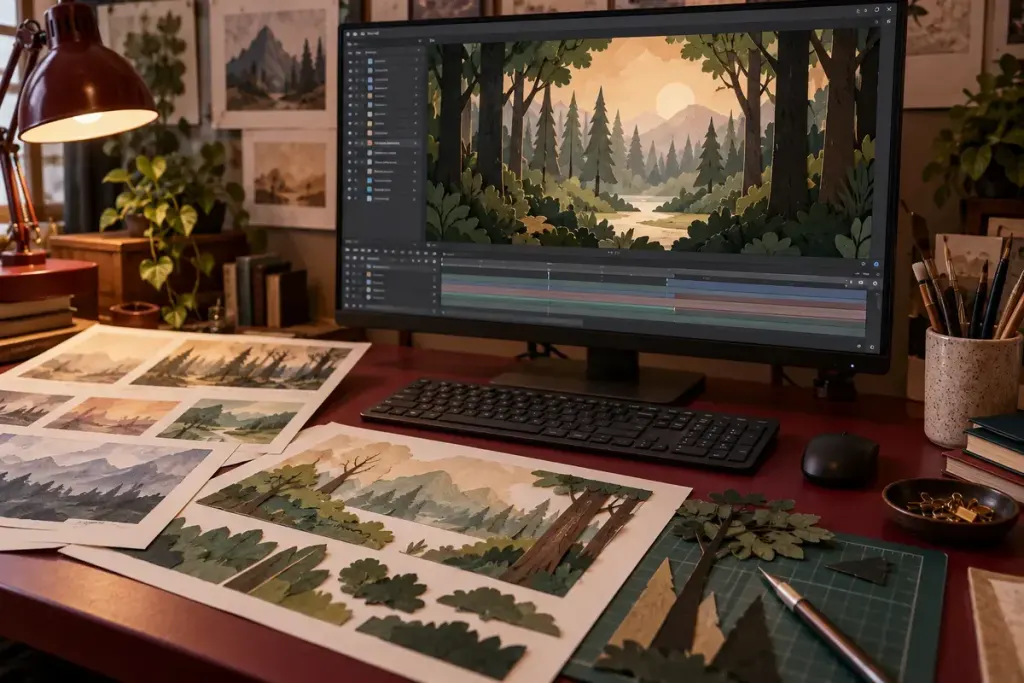
A character travels through a forest. A branch passes quickly across the foreground, nearby trunks drift more slowly, and the distant hills hardly seem to move. The artwork may be made from flat layers, yet the scene feels as though it contains space.
That relative movement is a parallax effect. Objects at different apparent distances move differently across the view as the camera travels. Animation can arrange those relationships deliberately, giving a painted background a sense of depth without building every object as a full three-dimensional model.
Watch the edges of the frame
During a slow scene, look beyond the main character. Which layer crosses the frame fastest? Which remains almost fixed? Does a foreground object briefly obscure the action? These details can make a journey feel spacious even when the character’s own movement is modest.
Adobe Animate’s layer-depth guidance describes using a camera with separated layer depths to create parallax. Different production tools implement the effect differently, but the visual relationship is something viewers can notice without knowing the software.
Try an original three-layer study
Draw a distant skyline, a middle row of trees and one large foreground branch on separate layers. Move the view sideways while allowing the branch to travel across the frame more quickly than the trees and skyline. Compare that with a version in which all three layers move together.
The second version may resemble a single backdrop sliding past. The first gives the eye clues about distance. Keep the experiment simple enough to see which change produces the effect; adding blur, camera shake and several speed changes at once makes that harder.
Check for gaps beyond the edges of the artwork as the layers move. A convincing still composition may need extra painted space outside the original frame. Also watch whether a fast foreground layer distracts from an expression or action that matters more.
Parallax is a storytelling choice as well as a technical device. A restrained background can hold attention on a quiet exchange, while a stronger difference between layers can make a passage through space feel more pronounced.