
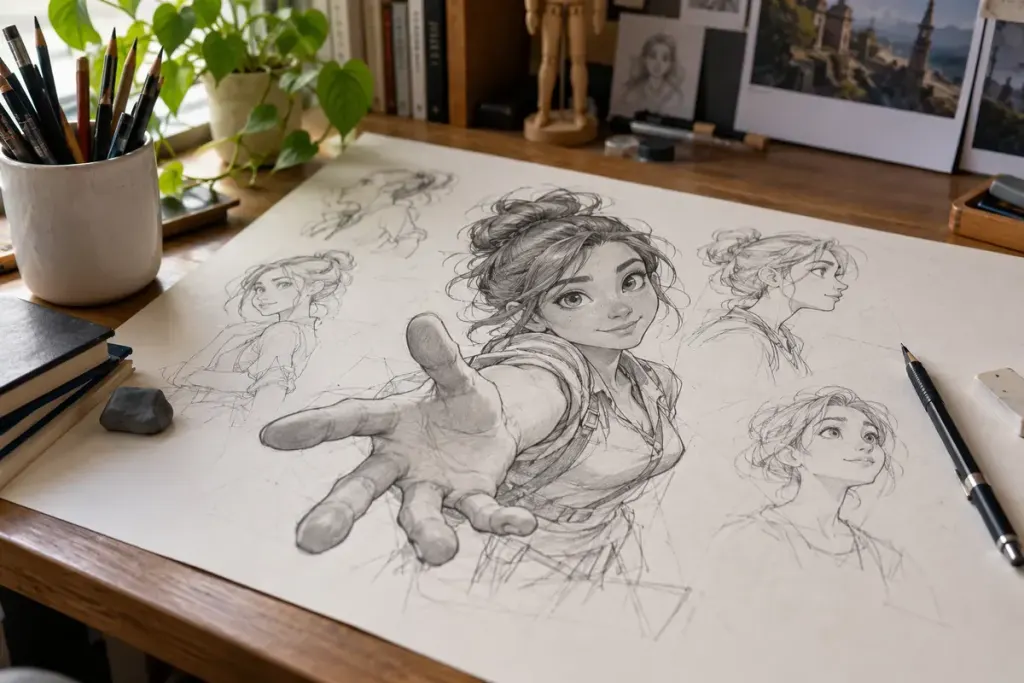
An arm pointing towards the viewer occupies less page length than the same arm stretched sideways. If you draw its familiar side-view proportions unchanged, it can look bent or strangely shortened. Foreshortening asks you to draw the projected view rather than the length you know the arm has.
Adobe’s hand-drawing guide recommends thinking in three-dimensional forms and observing how perspective changes their appearance. That approach is useful for expressive character art as well as realistic studies.
A short drawing exercise
Use a photograph you have permission to study, or pose your own arm comfortably. Keep the viewpoint fixed. Begin with three simple masses: shoulder, forearm and hand. Mark which form overlaps the next before drawing a clean outer contour.
Then compare widths and visible lengths. The nearer hand may appear large relative to the forearm; the elbow may be partly hidden. Do not automatically correct those observations to match a textbook side view.
Use a few cross-contour lines to suggest the direction of the forms. An ellipse around an imagined cylinder can help you think about the arm’s axis, even though the finished drawing will not contain that construction line.
Only after the gesture reads clearly should you add fingers, sleeves and facial details. In an anime-style pose, simplification can strengthen the action, but it should follow a coherent spatial idea. Extra shading will not reliably repair a confused overlap.
Make a second sketch from the same reference with fewer lines. Compare the two at thumbnail size. Ask whether the arm still appears to come towards you when small details disappear.
If the hand looks disconnected, inspect the wrist connection and the direction of the forearm. If the arm looks too short without depth, check the overlap and size relationships rather than simply extending it.
Keep both sketches and note one observation you want to test next time. This turns a difficult pose into a repeatable study, instead of treating one polished image as proof that you have mastered every viewing angle.