
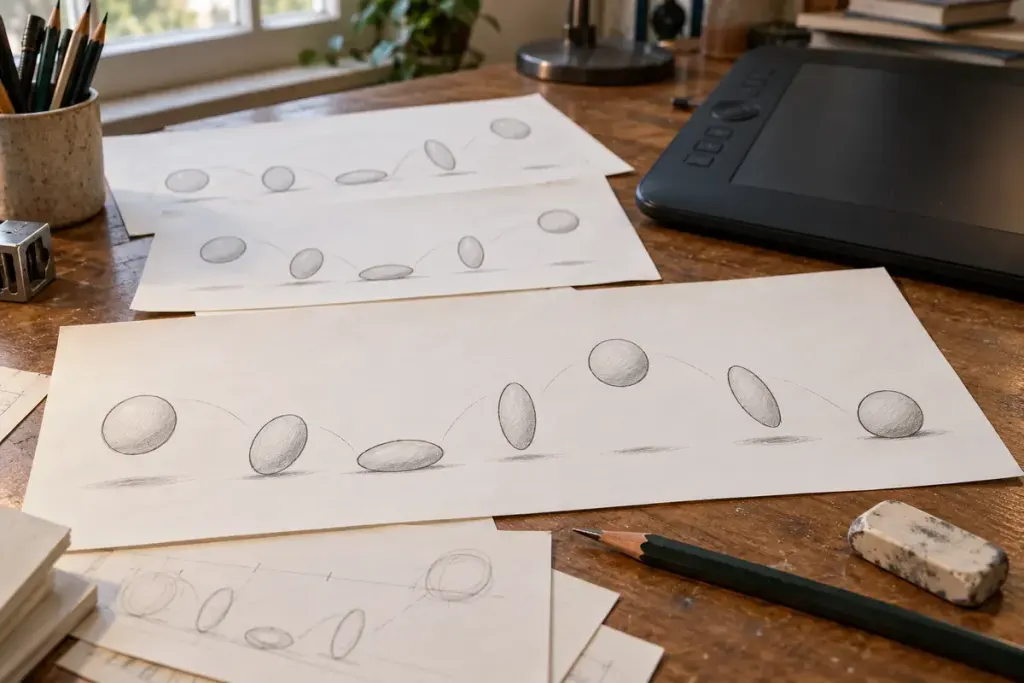
Pause an animated action at the wrong moment and a familiar shape may look stretched, multiplied or almost unrecognisable. During playback, that brief drawing can help the viewer feel the speed and direction of the movement. This is the territory of the smear frame.
Judge the transition, not only the still
A smear is designed in relation to the drawings around it. Its usefulness depends on timing, spacing and the intended style. A strange paused image is not automatically an animation error, just as an ordinary-looking drawing is not automatically a good transition.
Watch the action once at its intended speed, then slowly inspect the frames before and after the stretch. Ask where the movement begins, where it ends and what visual path connects them. Avoid assuming that every blurred image is a hand-drawn smear; compositing and other techniques can create related effects.
Try an original ball study
Draw a simple ball in two separated positions. Add a brief elongated shape between them, aligned with the direction of travel. Play the sequence, then change how long the middle drawing remains visible. This is an illustrative exercise, not a reconstruction of a particular studio’s method.
If the stretch stays too long, it may read as a new object rather than motion. If the surrounding positions do not establish a clear action, the smear may add confusion. Change one timing or shape decision at a time so you can see which adjustment helps.
When discussing an anime scene, describe the effect before judging it: faster impact, a comic snap or a fluid turn. Keep frame captures within appropriate permissions and avoid using an isolated awkward image as proof that the whole sequence is poorly made. Animation is built to unfold through time; the paused frame is only one way of looking at it.