
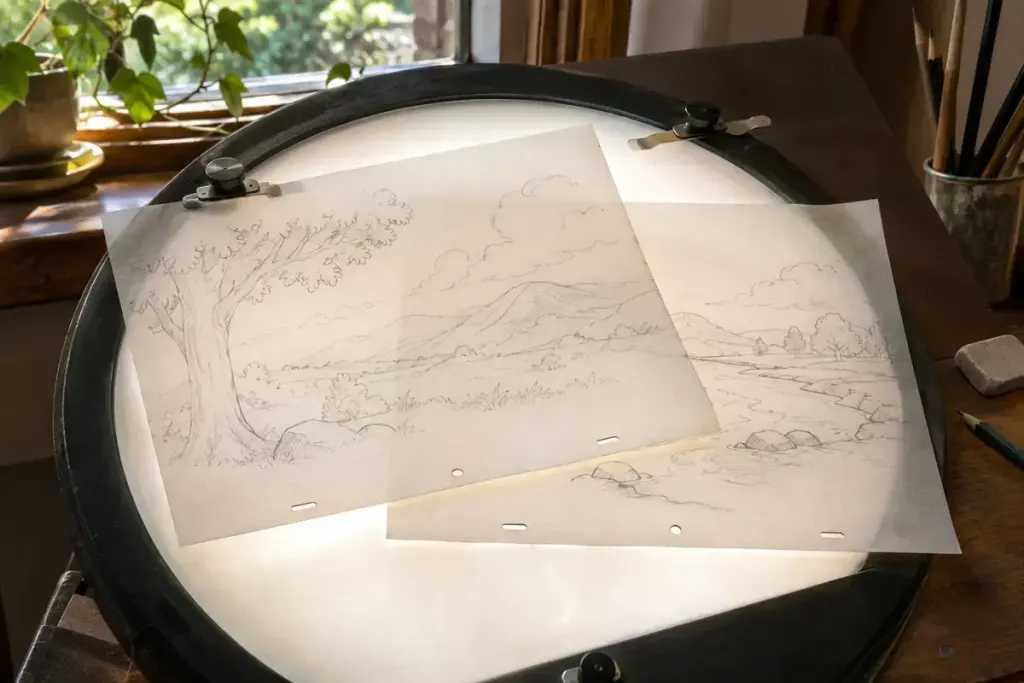
A round window fades into a moon. For a moment, both shapes occupy the screen together, and the audience feels a connection before the new setting becomes clear. A match dissolve combines a compositional match with the overlap of a dissolve. It can make an animated transition feel deliberate without adding another line of dialogue.
Two choices happen at once
A dissolve gradually replaces one image with another. The match comes from how the images relate: perhaps their shape, position, movement or brightness. A straight cut can also match those features, but it does not create the same interval of overlapping pictures.
Toon Boom’s transition documentation describes the available transition types in Storyboard Pro. Its animatic guidance places timing and transitions within the process of testing a sequence. That is a useful stage to examine the idea: a transition should communicate before the final drawings become expensive to change.
Try one match with three timings
For an original exercise, draw a character looking through a circular window, then a distant moon in a similar part of the frame. Make one version with a cut, another with a brief dissolve and a third with a longer overlap. Keep the drawings and surrounding shot lengths unchanged so that you can judge the transition itself.
Watch where your eye goes. Does the window remain recognisable long enough to connect with the moon? During the overlap, do two bright circles compete, or do they form one readable shape? If the match requires an explanation afterwards, adjust the composition before increasing the effect’s duration.
Sound provides another test. Play the sequence silently, then with its intended audio. An overlapping sound may already connect the scenes; the visual dissolve might reinforce that connection or make the change unnecessarily slow.
Give the connection a reason
A match can suggest memory, comparison or a passage from one place to another, but it does not have a fixed meaning. Consider what the surrounding story establishes. In a quiet reflective scene, the shared shape may invite attention. During a fast exchange, the same overlap may delay information the audience needs immediately. Choose the version that makes the sequence clearer, even if the simplest cut wins.