
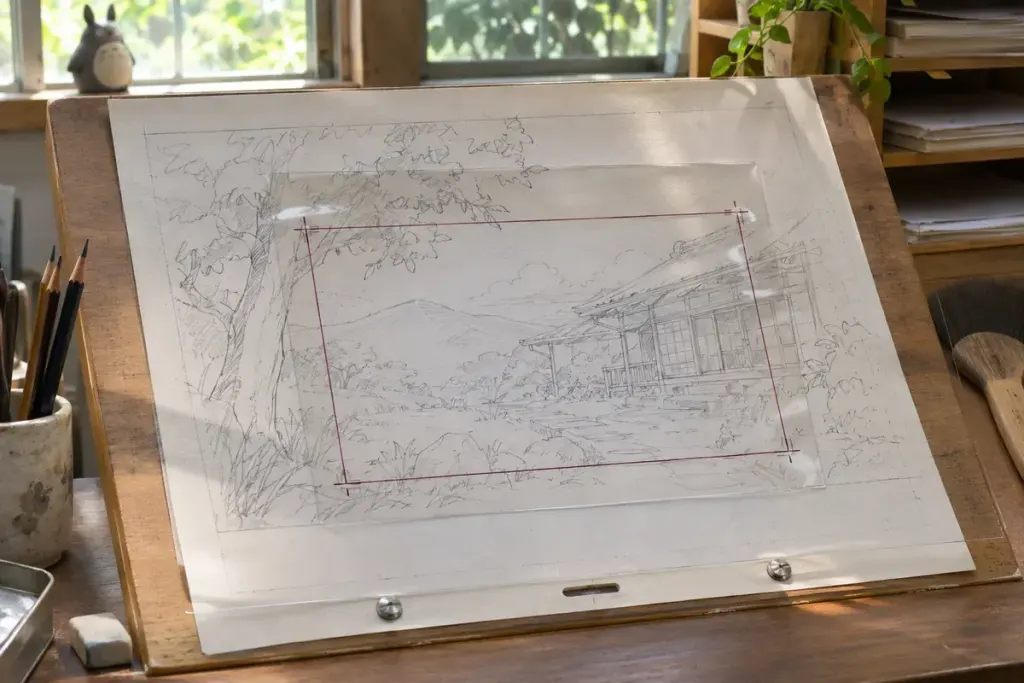
An animation background can extend far beyond the image the audience eventually sees. A field chart helps connect that large piece of artwork with the intended camera view. It provides a reference for framing and movement instead of leaving the camera operator or compositor to guess from the drawing’s edges.
Toon Boom’s explanation of cameras describes traditional animation field measurements and the field chart used to plan them. The chart belongs to the production’s working coordinates; it should not be confused with the pixel dimensions of a final video file.
Find the frame inside the artwork
Imagine a painted room extending across a wide sheet. The opening shot uses only the doorway at one end, then the view moves towards a table. The background needs enough artwork for both views and for the journey between them. Its physical paper edge is therefore not a dependable guide to the first composition.
Locate the marked camera frame and centre before assessing where a character appears. An apparently off-centre figure on the full sheet may sit exactly where intended inside the camera view. Conversely, a pleasing whole-page drawing may leave an awkward crop in the actual frame.
Read the start and finish together
When a camera move is indicated, compare its endpoints. Check what enters the frame, what leaves it and whether the background supports the entire movement. A move also needs timing information elsewhere in the production instructions; two frame positions alone do not specify how quickly the view travels.
For a small practice exercise, draw a wide room and place two rectangular frames over it. Keep a simple object visible in both. Then imagine the intermediate views. This reveals why planning only the attractive start and finish can leave an awkward passage in between.
Digital tools can express the framing through camera controls rather than a physical overlay, but the question remains concrete: which part of the artwork is the viewer meant to see at this moment? Reading that relationship makes production drawings much more informative than treating every line on the sheet as part of the final image.