
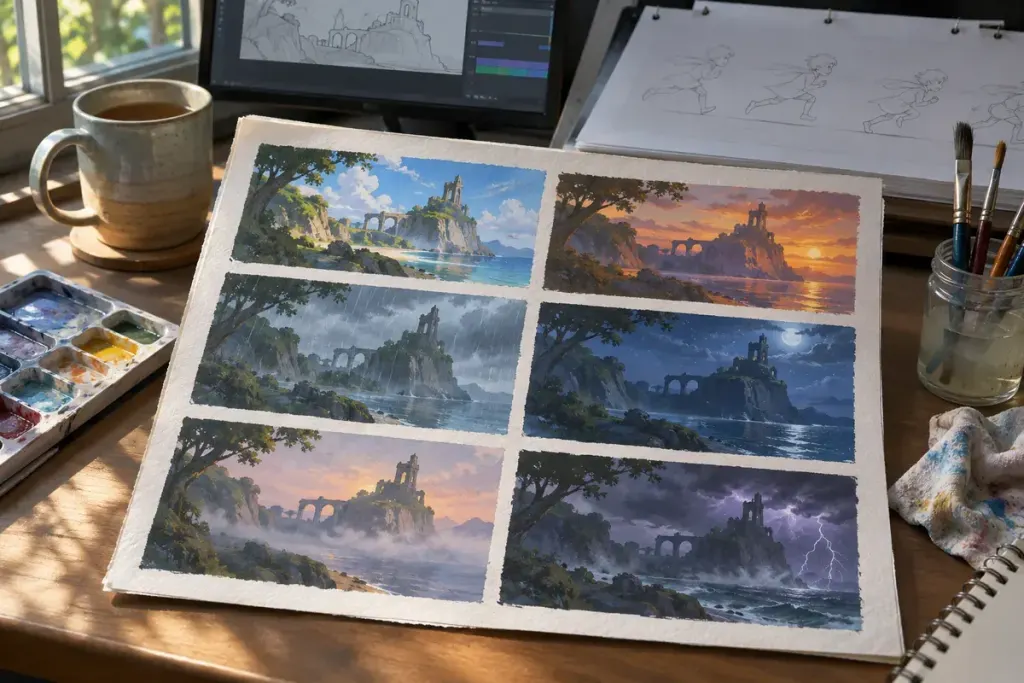
A single beautiful frame can tell you a great deal about an animated film’s palette. A sequence of small colour studies can reveal something else: how the visual mood is intended to change across the story.
A colour script is one way of planning that progression. Walt Disney Animation Studios’ visual-development page includes examples within its own production process. It is a useful illustration of the concept, not evidence that every anime studio uses an identical workflow or terminology.
Follow the transition
Imagine an original sequence in which a character leaves a warm kitchen, crosses a pale morning street and enters a dim blue workshop. The meaning comes partly from the movement between those spaces. Calling the workshop simply “blue equals sadness” would ignore the preceding scenes, the character’s actions and the lighting context.
For a viewing exercise, choose three or four moments from one short sequence. Describe brightness, contrast and dominant colours before proposing an emotional interpretation. Note whether the change occurs at a cut, gradually within a shot, or after a story event.
Then ask what stays consistent. A small warm colour associated with the character might remain visible through several environments. Or the palette may deliberately become less distinct at a moment of uncertainty. These are interpretations to support with the frames, not universal rules.
Keep the finished scene separate from the planning artefact
Without published production material, you cannot know exactly which colour studies preceded a scene. Describe what you observe in the finished animation rather than inventing a director’s intention.
A useful review sentence might say, “The shift to lower contrast makes the room feel quieter to me,” followed by the relevant visual detail. That is more precise than claiming an undocumented colour code explains the whole episode.
Colour scripts invite attention to rhythm across images. Whether you are analysing anime or another form of animation, the most interesting question is often how one palette changes the experience of the next.