
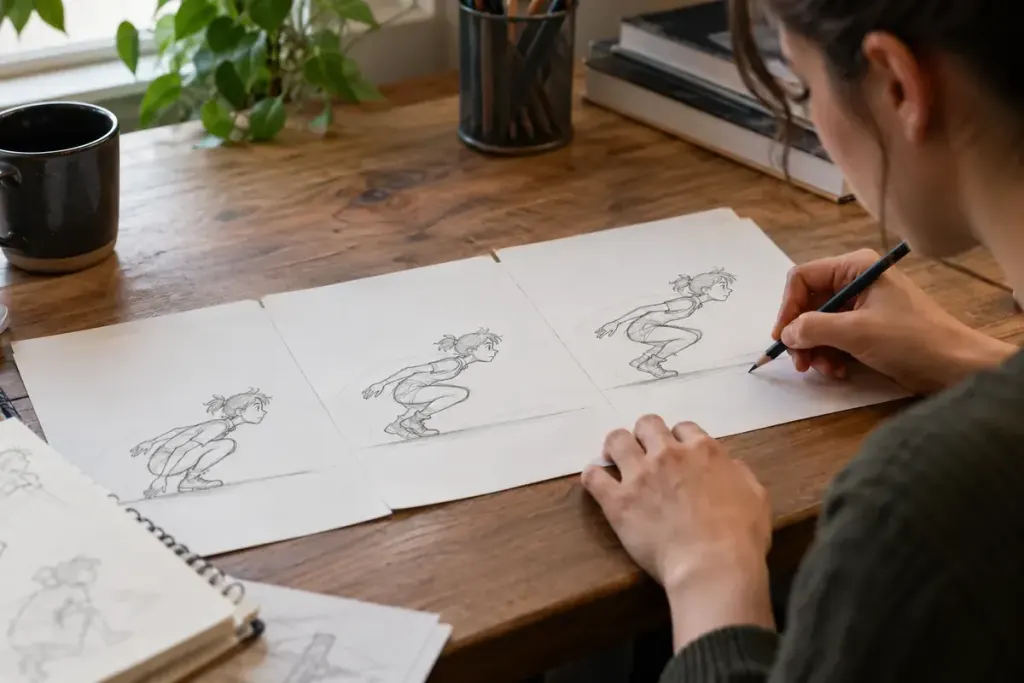
A character crouches before jumping, draws an arm back before throwing or glances toward a door before running through it. The audience receives a small preparation for what follows. In animation, that preparation is often discussed as anticipation.
Toon Boom’s lesson on anticipation presents it as an animation principle. It can help an action read clearly, but it also offers a way to shape the viewer’s expectation rather than merely reproduce physical movement.
Choose a short scene and identify the action you remember most. Replay the preceding moment. Does the character shift weight, change expression, look toward a target or pause? The preparation may be much smaller than the action it introduces.
A drawn-out preparation can make the audience wait, while a brief one can keep a sequence brisk. An action with little obvious preparation may feel abrupt or surprising. These are observations about the scene’s effect; they do not establish the animator’s intention without production evidence.
Compare the relationship, not a single pose
A crouched drawing alone is not enough to explain anticipation. Look at its place in the sequence, how long it lasts and what follows. The same pose can have a different function in another context.
- Identify the main action.
- Describe the preparation in plain words.
- Notice whether the camera or staging directs attention toward it.
- Compare the preparation’s size and duration with the action.
Try sketching three simple poses of a bouncing or jumping shape: preparation, action and result. Change the preparation while keeping the main action similar, and consider how the sequence reads.
This way of watching makes an animated scene easier to discuss precisely. Instead of saying only that movement feels lively, you can point to the small expectation created before it happens.