
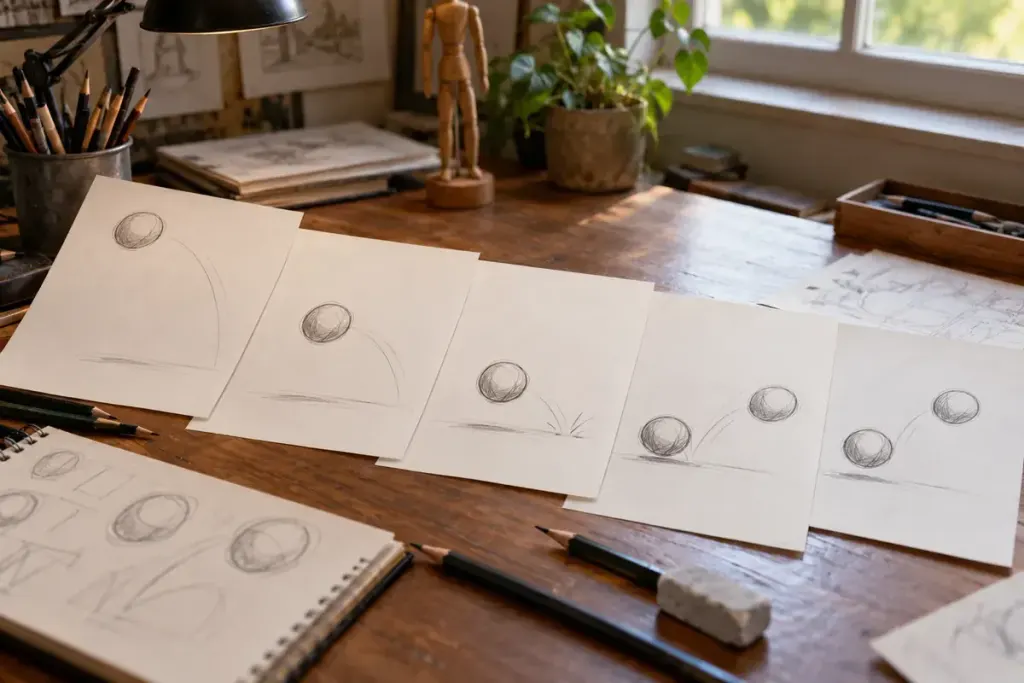
A character lifts a cup, pauses and changes their mind. The movement can be understood through a few decisive poses, but its feel also depends on what happens between them. Key drawings and in-between drawings contribute different parts of that action.
In pose-to-pose work, key drawings establish important positions or moments. In-betweens connect those drawings according to the planned movement and timing. Clip Studio’s official in-betweening tutorial shows a practical drawing process using existing keyframes as references.
Watch the cup, then the hesitation
Watch a short, legally available scene once at normal speed. Where does the intention change? The hand leaving the table, the cup nearing the mouth and the hesitant pause may each communicate something different.
Then examine a small section more slowly where the viewing tool permits it. Notice how the head, shoulders and hand relate. Do not assume that a striking still image alone explains the scene; its placement among other images matters.
The space between poses
Two movements can begin and end in similar poses but feel different because the intermediate positions are distributed differently. Small changes near a pause can feel unlike larger changes during a quick action. Timing also depends on how long drawings are held.
More drawings do not automatically mean better storytelling, and a held image is not automatically a production mistake. Judge what the sequence communicates before turning a frame count into a quality score.
For a simple observation exercise, sketch three rough positions of an ordinary object moving across a table. Choose where it should slow down, then consider what additional positions would make that intention readable. This is a study of movement, not a reconstruction of a studio’s exact workflow.
When reading credits, remember that responsibilities and terminology can vary by production. The useful distinction is between establishing the action and connecting its moments, while recognising that both require careful visual judgement.