
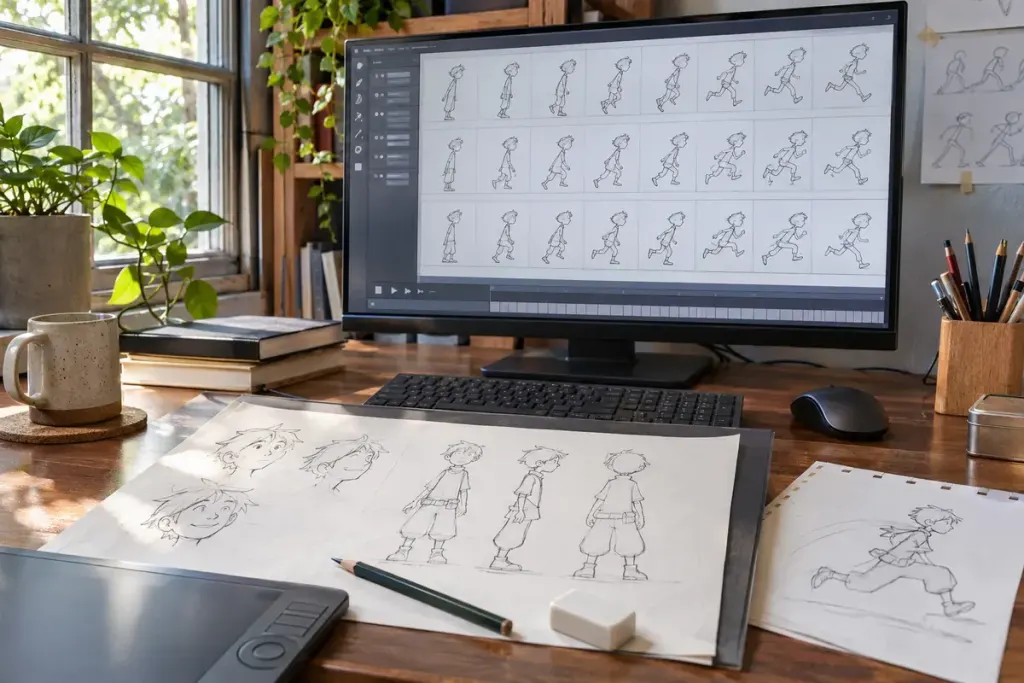
A folder full of drawings is not yet a useful animation bank. A production team must be able to find a suitable shot, identify what it contains and understand whether it can be used in the next scene. Storage and retrieval are different parts of the job.
Animator Sadao Tsukioka’s account of the bank system recalls organising material such as walking, flying and expression shots for reuse. He describes a coordinator looking through the bank after a new storyboard was completed. That practical detail is easy to overlook when discussion focuses only on recognising repeated footage.
Give the stored shot an identity
For an illustrative small animation project, imagine that three short walking shots have been completed. One moves left, another right, and the third approaches the viewer. Calling all three files “walk-final” would make them difficult to distinguish even before a revision arrived.
A proposed catalogue could record a stable shot identifier, the character, action, screen direction, duration, version and the location of the approved file. Add a thumbnail for recognition, but keep the text fields: a thumbnail may not reveal that a shot contains a turn near its end.
Keep approval and reuse conditions with the material
State which version was approved and whether the project has the rights needed for the planned reuse. Preserve source files and their dependencies through the team’s normal production process. A flattened preview is helpful to browse, but it may not provide the editable material required for a new composition.
This catalogue is an original workflow example, not a reconstruction of Tsukioka’s studio records. His account establishes the historical importance of selecting and organising banked material; the suggested fields show one way a small contemporary team might make that task explicit.
Test whether someone else can find it
Give a teammate a simple request, such as a rightward walk of a particular character, and see whether the record leads to the correct approved asset. Improve ambiguous labels before adding hundreds more files. A useful bank saves searching as well as drawing, because the stored work remains understandable after the person who made it has moved to another shot.