
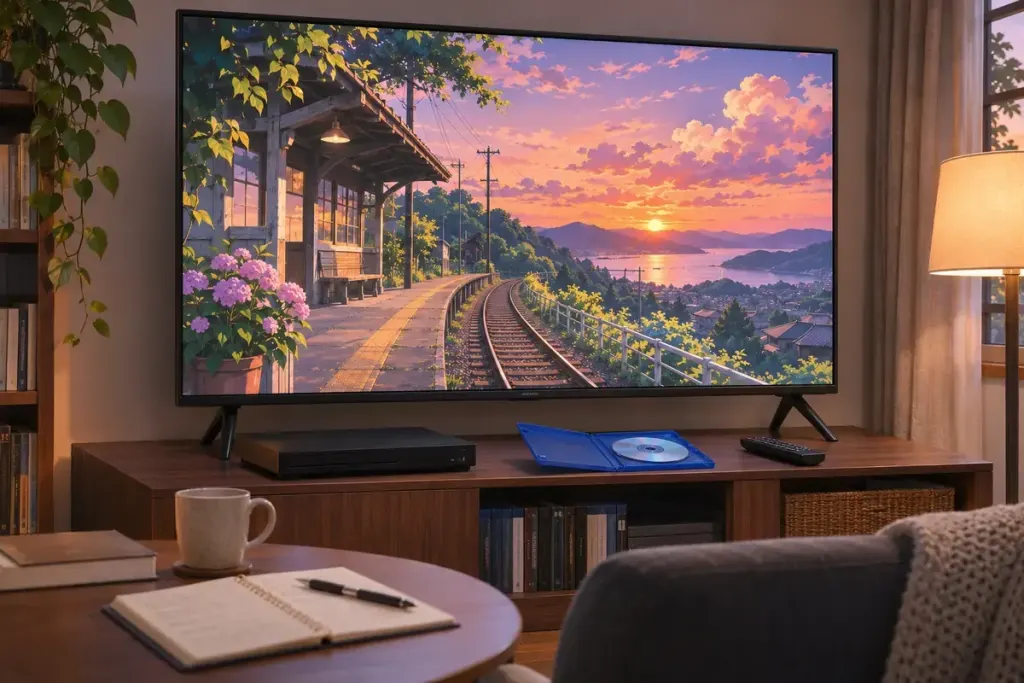
A name appears just as an animated train crosses a bridge. Your eye follows the lettering, then returns to the train. Watch a textless version of the same opening and the balance may change: a movement or small background detail can become easier to notice.
In anime home-video extras, a textless opening usually means a presentation without the overlaid credit lettering. It is worth checking the actual feature rather than assuming the label promises a different animation, an extended song or a version with every sign in the pictured world removed.
Check the edition, not only the series title
Aniplex of America’s 2019 announcement for the Kaguya-sama: Love Is War complete Blu-ray set lists a textless opening and several textless endings, including the ending from episode three. That is evidence about that announced edition; it does not establish the extras on every later release or streaming service.
Before buying an edition for this feature, match its product details and bonus list. A song appearing on a soundtrack album is a different item from an opening video. Likewise, a disc’s subtitle setting and credit lettering built into a video are separate things to check.
Give the comparison one clear question
Choose a short passage you can revisit comfortably. Watch the regular opening first and note where your attention goes. Then view its textless counterpart, checking that you are comparing the same sequence version rather than two openings revised during the series.
Try one of these observations:
- Does a moving object become easier to follow when lettering no longer crosses it?
- Does an apparently empty corner reveal a background detail?
- Does the rhythm still feel the same when you stop reading names?
Write down what changed in your viewing, not what you imagine the production team intended. A credit’s position can be part of the composition, so the regular presentation remains worth studying in its own right.
The extra is especially useful when it prompts a second look at familiar images. It offers another presentation to compare, while the credited sequence preserves the names and visual arrangement viewers originally encountered.