
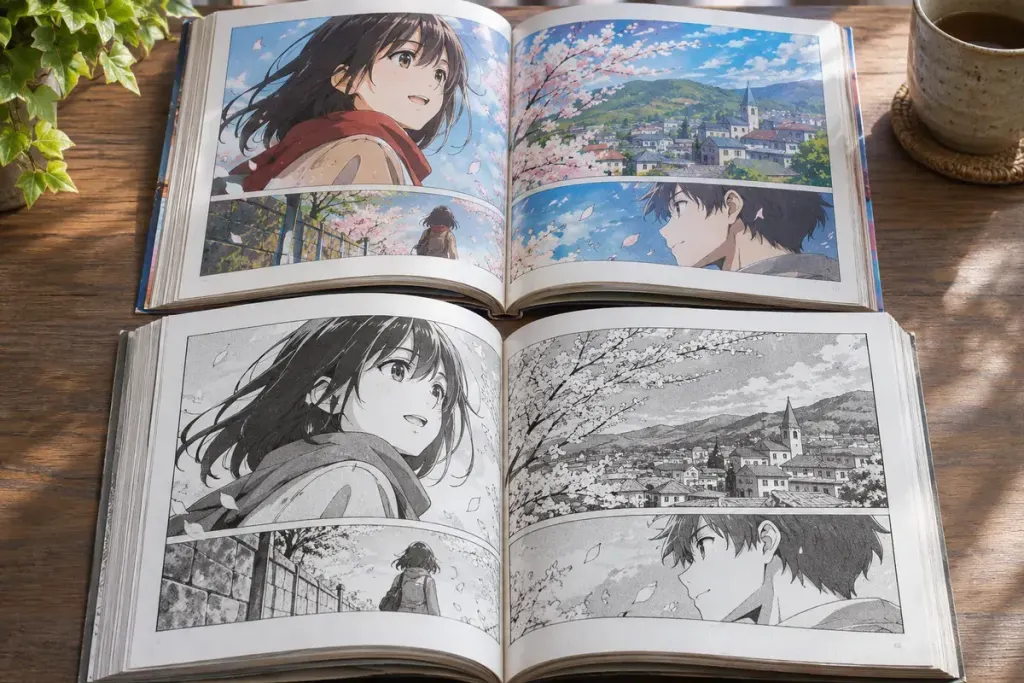
Colouring a manga panel is not limited to filling the spaces inside black outlines. The lines themselves can change colour. A dark contour, a softer edge and a coloured burst of action lines can give the same composition a different visual emphasis.
In its official colour-manga background tutorial, Clip Studio shows how saturated and stream-line effects can be changed from monochrome to colour. The example makes line colour an editable design choice rather than an inseparable property of the original drawing.
Change the lines while keeping the drawing still
Try an original practice panel containing a simple character silhouette and a few radiating background lines. Duplicate it before experimenting. Keep the shapes, spacing and filled areas identical in both versions, then change only the colour of the background lines.
In one version, use a dark neutral; in the other, try a colour related to the background. Compare where your eye goes first. Does the effect support the character, compete with it or nearly disappear? There is no rule that the coloured version must be better.
This exercise is easiest to understand when the altered element stays on a separate editable layer. Use the controls documented for your software and version; the named tutorial describes a particular Clip Studio workflow.
Judge the panel at reading size
A delicate edge that looks attractive while zoomed in may become hard to see on a phone or printed page. Reduce the preview to its intended size and check the character’s expression, silhouette and separation from the setting.
Then view the panel beside its neighbours. A line treatment can work beautifully in isolation while drawing too much attention within the sequence. The question is what the reader needs to notice at that moment in the story.
Observe published work without guessing its production
When looking at a legitimate colour edition or publisher preview, note which edges stay dark and which merge with nearby colour. Treat this as an observation about the visible page. Credits and production notes are needed before attributing a technique to a particular artist or software.
A small change of line colour can alter emphasis without moving a single figure. Learning to notice that choice adds another layer to both drawing practice and attentive manga reading.