
A painted street looks convincing as a still image. Move it across the frame and repeat it, however, and a fence suddenly jumps upward at the join. A looping background needs its two ends to cooperate before the artist spends hours finishing windows and leaves.
In Toon Boom’s guide to looping backgrounds, seamless artwork comes before the software setup. The guide recommends checking that the beginning and end align, with simpler detail around the seam where useful. A loop command cannot repair an accidental mismatch in the painting.
Make a rough strip and duplicate it
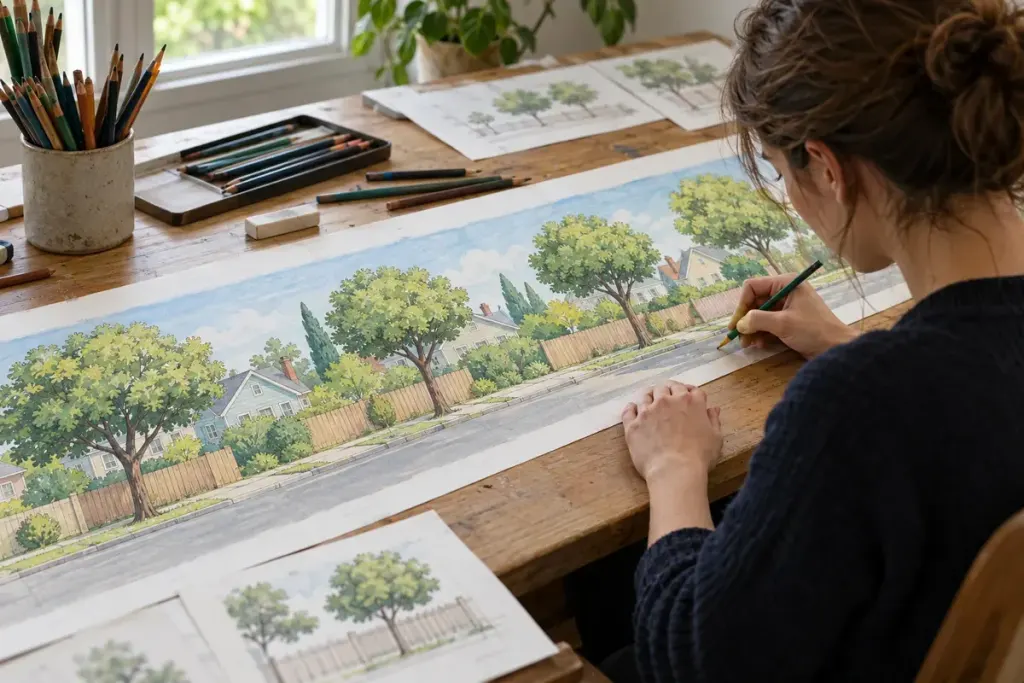
For a small practice exercise, draw a horizontal strip containing a pavement, fence and two trees. Keep it rough. Place a copy directly beside it in your drawing application, or print two copies for a paper check. Inspect the join at the size the audience will actually see.
Follow the ground line across the boundary. Then check the fence height, sky colour and direction of any shadows. A mismatch can remain noticeable even when the trees themselves look natural. Correct the relationship between the ends rather than hiding the seam behind increasingly complicated detail.
Use a narrow viewing window to inspect the strip as it moves. This can reveal a recurring landmark that dominates the composition or an empty section that passes through the frame for too long. The full panorama and the moving crop are different tests.
Test motion before final polish
In the animation software, follow its supported method for repeating the movement. Check the transition between the final and initial positions as well as the artwork. An unintended pause or change in speed can expose a join that looks fine when stationary.
Keep the rough version until the timing works. Only then add the detail that the shot needs. The finished strip does not have to be visually busy: a clean, tested boundary gives the character room to move without a distracting bump every time the background repeats.