
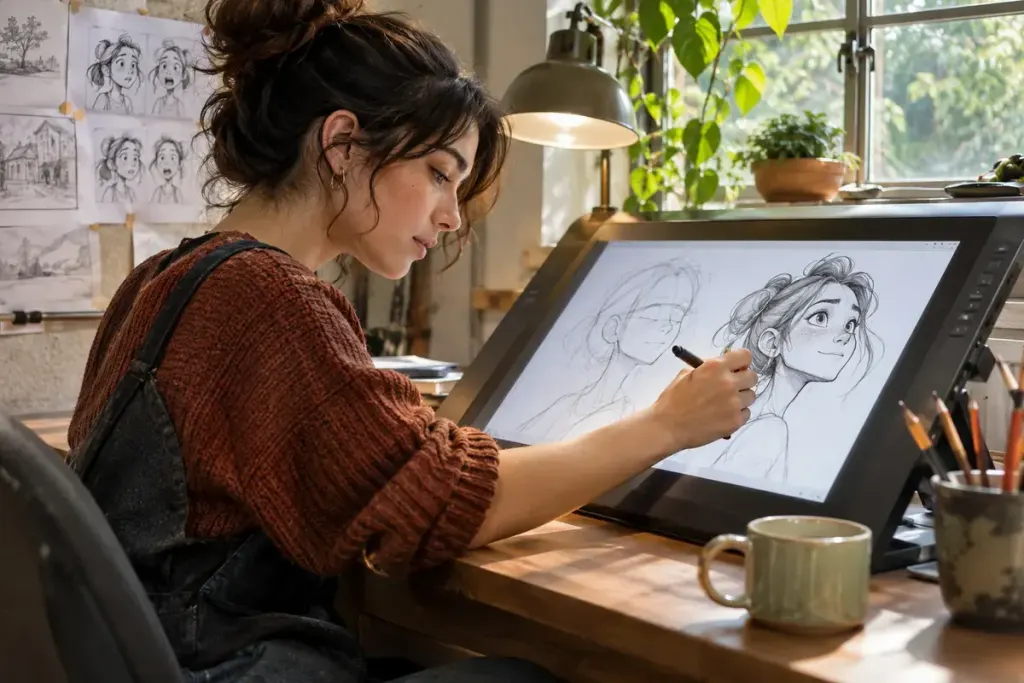
A rough animation drawing may contain several competing lines around a shoulder, an unfinished hand and a lively sense of movement. A tie-down pass tries to resolve the construction while keeping that movement alive. It is not merely a request to make every line darker.
Toon Boom’s tie-down animation guidance describes refining the rough drawings and bringing their forms into clearer agreement with the character design. That provides a useful distinction from planning a scene or adding its final surface polish.
Resolve what the rough drawing means
Suppose a character reaches across a desk. The rough pass establishes the reach and its timing, but the elbow has been suggested with several strokes. The tie-down artist needs to decide where the arm actually sits, how its volume turns and how the hand connects. A clean line around an unresolved shape would only preserve the ambiguity.
Compare neighbouring drawings as well as individual frames. Does the head keep a believable volume while rotating? Does a sleeve remain attached to the same part of the arm? A beautifully finished isolated frame can still create a jump when placed between its neighbours.
Keep the action available for comparison
When practising digitally, preserve the rough pass on its own layer or version. Toggle between the two and play the movement at its intended speed. The comparison helps reveal whether careful drawing has inadvertently stiffened the pose or changed the gesture.
Try a short exercise with a simple character picking up a cup. Choose one construction problem to resolve, such as the hand’s relationship to the handle. Avoid adding elaborate costume details until the movement and forms are readable.
Production terminology and the division of work vary between studios. A published process image does not establish exactly which department made it. What you can examine is the drawing’s job: does it make the underlying action and construction clearer for the next stage?