
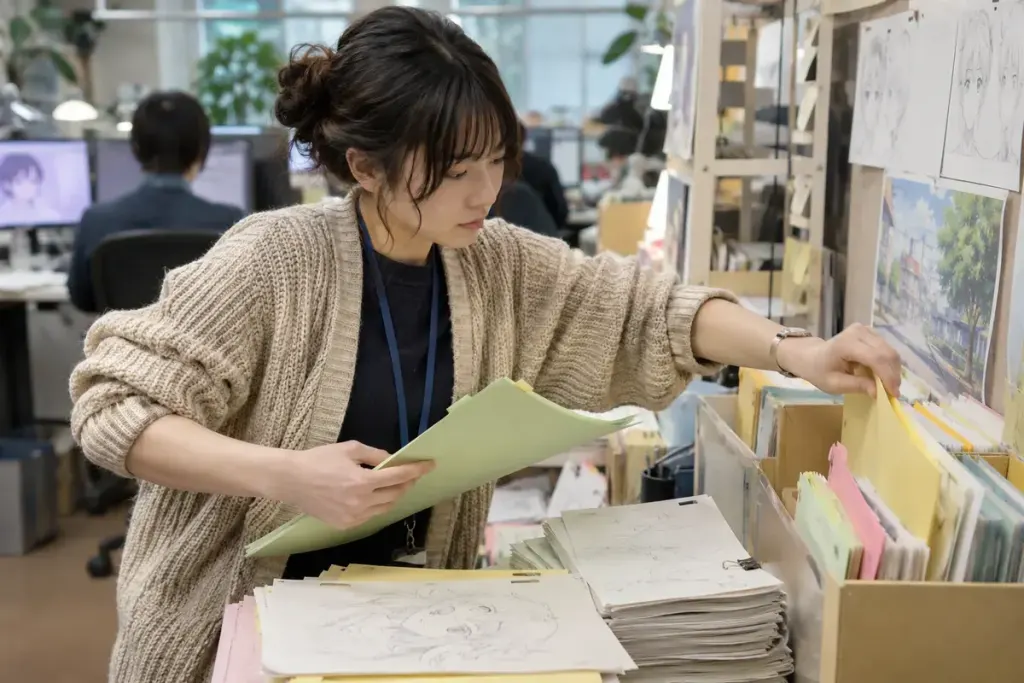
An episode may contain a beautiful cut that took many specialists to complete. Someone also needed to know which version was current, who was waiting for it and when the next department needed the material. That coordination is part of making animation, even though it does not appear as a drawing on screen.
Production assistants and related coordination staff support that movement of work. Exact job titles and responsibilities vary by studio and project. They should not be confused with an assistant animator, whose role may involve directly contributing to the animation work.
In its own department description, MAPPA explains that its production teams manage schedules, requests, delivered materials and project completion. That describes a division’s work; it does not mean every junior assistant controls budgets or makes final creative decisions.
Follow a hypothetical revised cut
Imagine a scene has been returned for a correction. A useful handover must identify the cut, the version under discussion, the requested change and the person responsible for the next action. “Please fix the latest file” is weak communication if several people have different copies called latest.
In this invented example, production support might update the tracking record, confirm the request reached the right person and check when the revised material will be available. The artistic decision still belongs to the relevant creative staff. Coordination makes the decision traceable and helps the next stage avoid using an obsolete version.
ScreenSkills’ animation production-coordinator profile provides another view of the administrative and communication work involved. Its industry context is broader than Japanese anime, so the title should not be treated as an exact translation of every studio credit.
A different way to read the credits
When watching an episode, notice the production-management names alongside the creative departments. Do not infer someone’s personal workload or working conditions from the length of the credit list alone. Instead, use it as a reminder that completed animation requires both skilled artwork and reliable handovers.
The finished scene hides much of that coordination. Learning to notice it makes the production process more interesting without reducing the work to a single director, animator or studio logo.